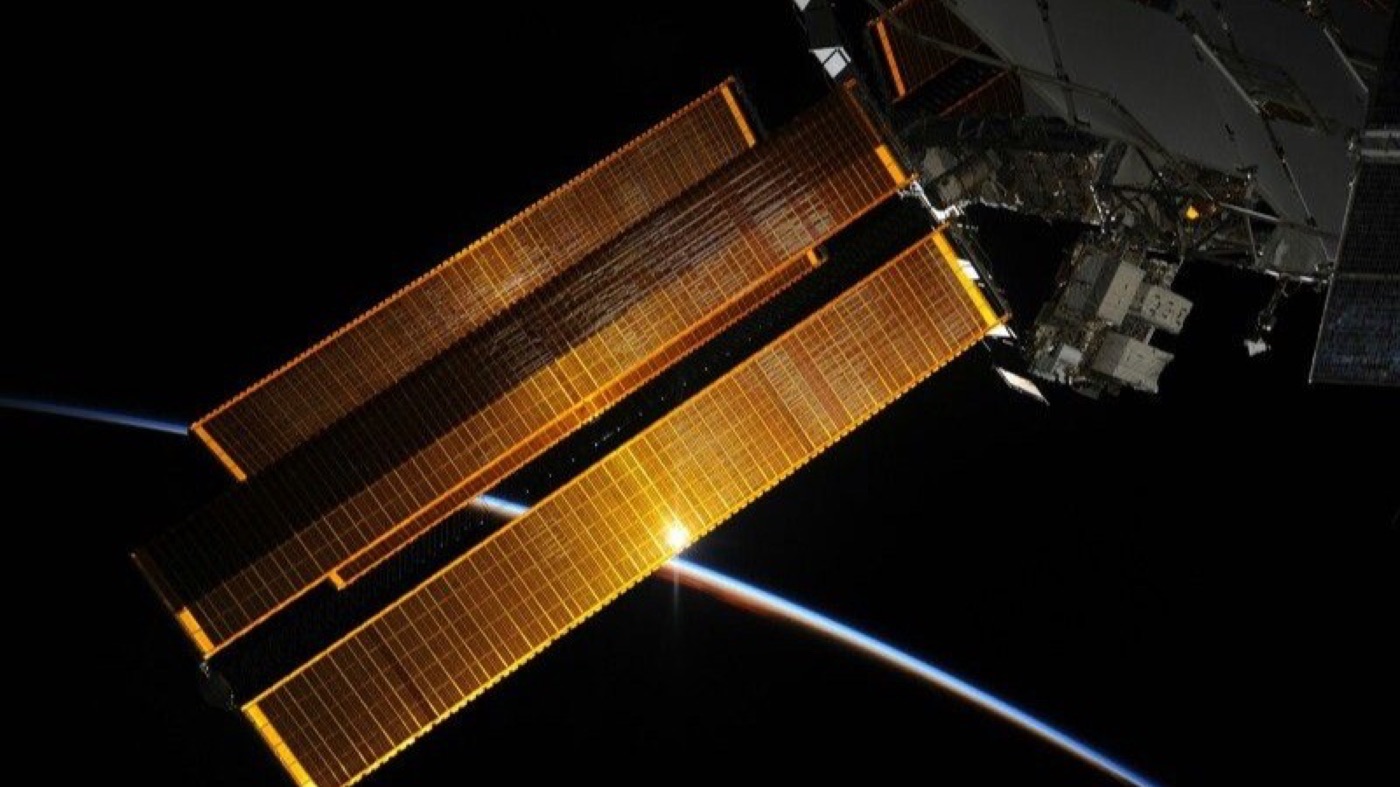
Low Earth Orbit is about to need what every economy has needed: transport, communications, and power
It has the first two, @SpaceX cut launch by an order of magnitude, laser crosslinks turned orbit into a network. But every satellite up there is still an energy island, capped forever by the solar panels it launched with, unable to buy a single extra watt at any price
That is the last missing layer, and it is the one everything else waits on
01The idea is a century old
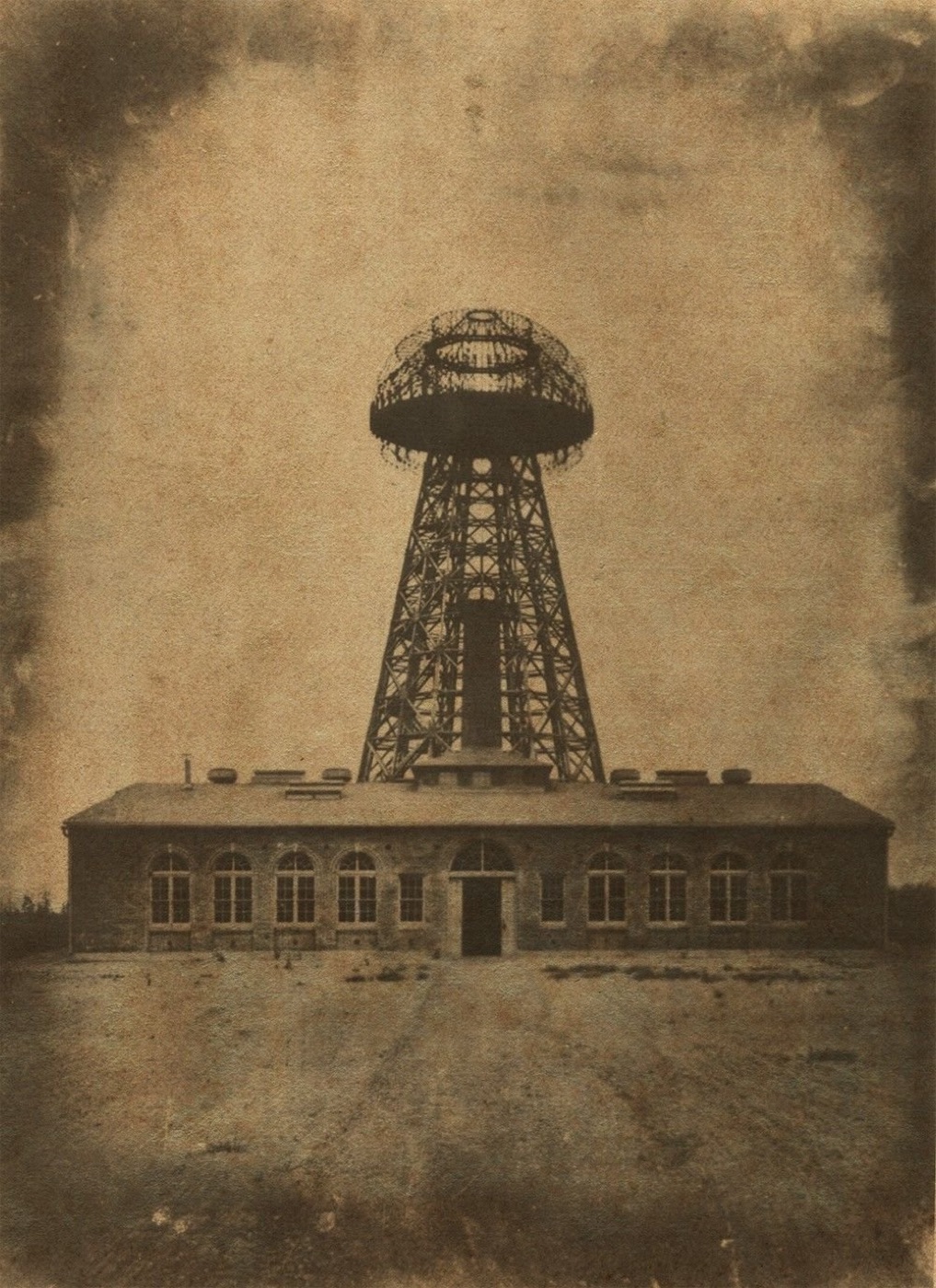
Nikola Tesla spent the last productive years of his life on a single conviction: Electricity should not need wires. Wardenclyffe Tower, built on Long Island starting in 1901, was meant to be the first node of a global wireless power network. It never worked, the money ran out, and the tower was demolished for scrap in 1917
But the idea survived him
In 1941, Isaac Asimov wrote Reason, a short story set on an orbiting station whose only job is to collect solar energy and beam it to the planets. It is a story about a robot that refuses to believe humans built it, but the setting is the interesting part, Asimov drew the machine before anyone drew the physics
The physics arrived in 1964, when William C. Brown flew a small helicopter powered entirely by a microwave beam from the ground. No fuel, no battery, no tether. It hovered for ten hours. That same year, Nikolai Kardashev published his scale of civilizations, whose first real rung is a species that captures the full energy output of its planet, and whose obvious next step is to stop being limited by a planet at all
NASA and the Department of Energy studied all of this very seriously through the 1970s. The conclusion was always the same, and it was never about physics: the collectors were kilometers across, the launch cost was measured in thousands of dollars per kilogram, until spaceX came
02Why now: satellites are starving
Here is the thing almost nobody outside the industry knows, The average satellite in orbit today generates less than a kilowatt
That is not enough to run one AI-class GPU, not a single one.
A modern datacenter accelerator draws around a kilowatt by itself, and the spacecraft carrying it has to also run its radios, its reaction wheels, its thermal system, and stay alive through eclipse
Power has quietly become the binding constraint on everything interesting in orbit, especially heavy applications:
- Direct-to-cell connectivity needs raw transmit power to close a link with an unmodified phone in someone's pocket
- Earth observation with onboard AI means processing terabytes in orbit instead of downlinking raw pixels, which means compute, which means watts
- Agile maneuvering, the thing every defense customer now wants, means electric propulsion, which is a power problem wearing a propulsion costume
- In-space manufacturing, furnaces, pumps, crystal pullers, is almost pure electrical load
- Orbital data centers, the whole emerging category, are a power business with a compute wrapper
Orbital data centers, the whole emerging category, are a power business with a compute wrapper
And a satellite's power budget is fixed the day it is designed. You size the solar array, you size the battery, you size the bus around them, and then you launch it and live with that number for a decade
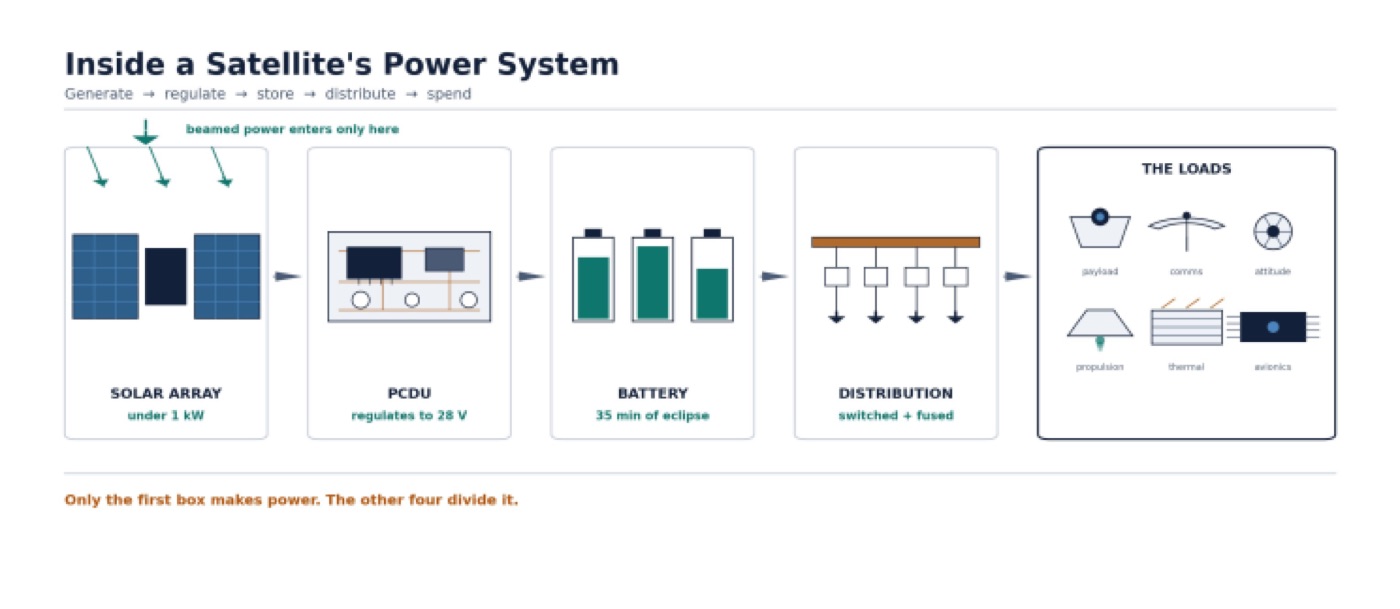
So what happens if you want more power? You need to build a bigger array and factor this since inception. Bigger array means bigger bus, more mass, more launch cost, more stowage volume, more deployment mechanisms that can fail
Power is the tax that compounds through every other subsystem. while the launch cost problem that killed Glaser's version has largely been solved by SpaceX. What replaced it is subtler: not the cost of getting to orbit, but the cost of doing anything once you are there
You don't see every factory building their energy store on their doors, so there must be another way, right?
03The company
Star Catcher Industries was founded in 2024 in Jacksonville, Florida, by Andrew Rush and Michael Snyder, both from Made In Space, the company that put the first 3D printer on the ISS and was later acquired by Redwire, alongside Bryan Lyandvert, who runs operations
The company is building the first power grid in orbit. the company's premise is that every satellite ever launched has been an energy island, generating only what its own solar panels can produce and capped forever by a decision made at design review years before launch
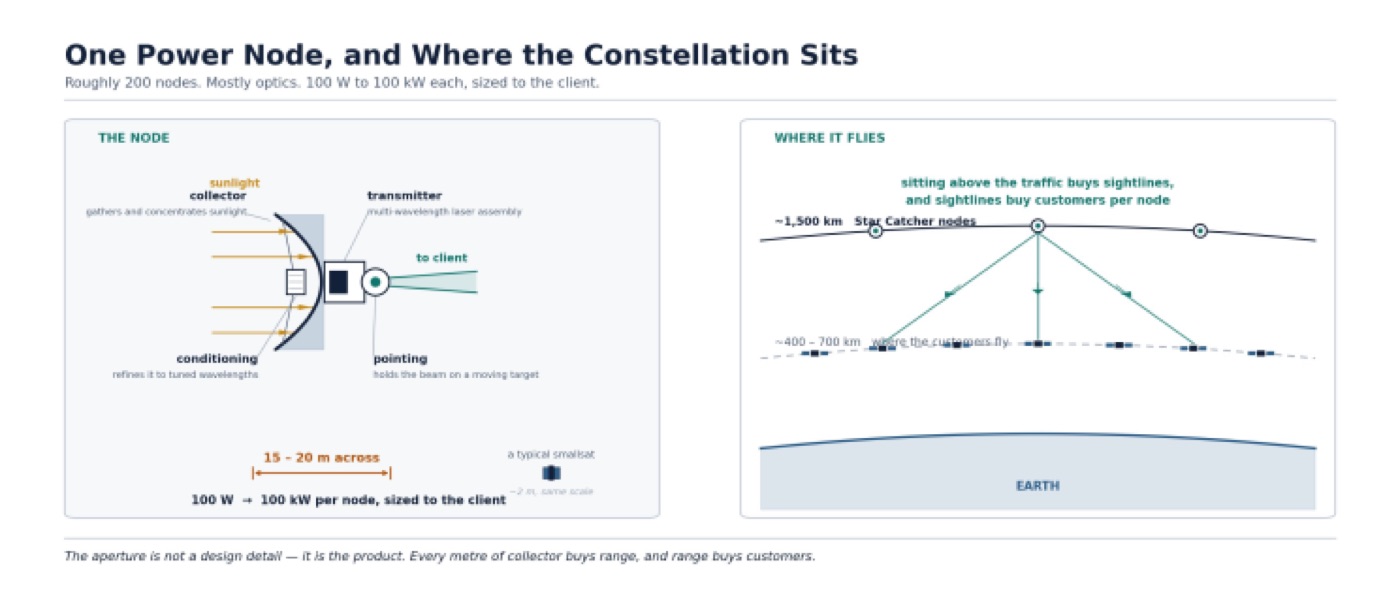
Their main product is a planned constellation of roughly 200 satellites that collect sunlight, refine it into wavelengths tuned to the bandgaps of standard space solar cells, and beam it down to client spacecraft, which absorb it through the arrays they already have
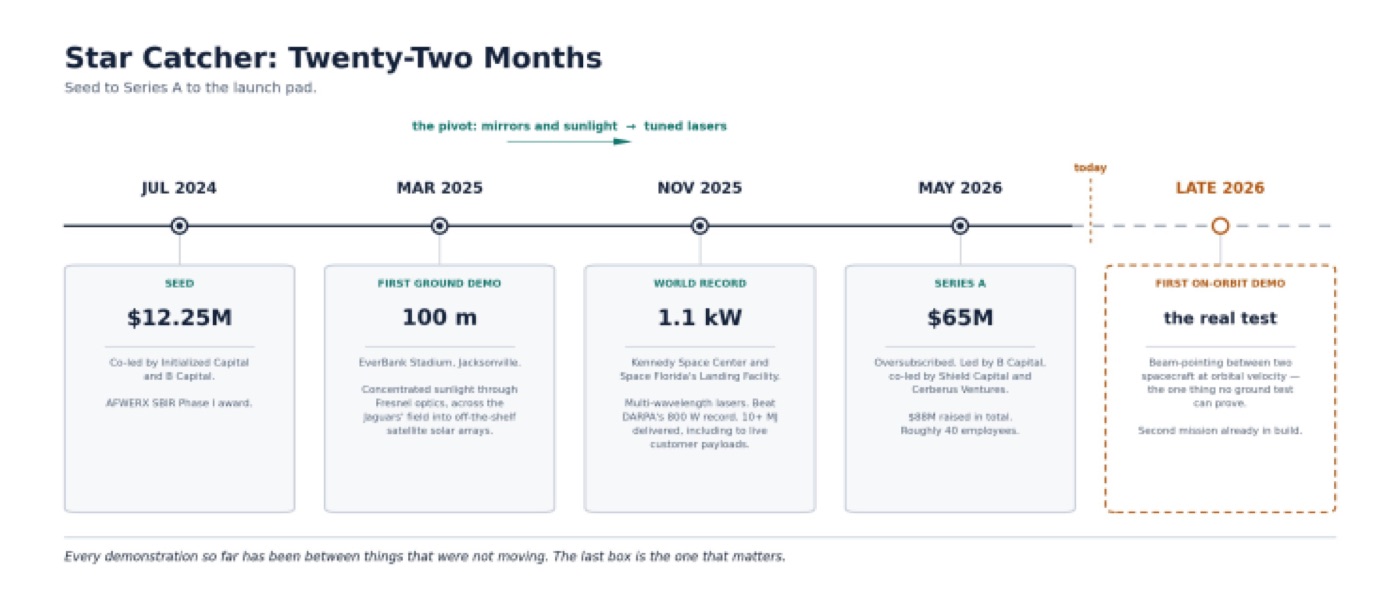
The timeline were unusually fast:
- July 2024: $12.25M seed, co-led by Initialized Capital and B Capital. AFWERX SBIR Phase I award
- March 2025: first end-to-end ground demo, at EverBank Stadium in Jacksonville. Concentrated sunlight, Fresnel optics, 100 metres across the Jaguars' field into off-the-shelf satellite solar arrays
March 2025: first end-to-end ground demo, at EverBank Stadium in Jacksonville. Concentrated sunlight, Fresnel optics, 100 metres across the Jaguars' field into off-the-shelf satellite solar arrays
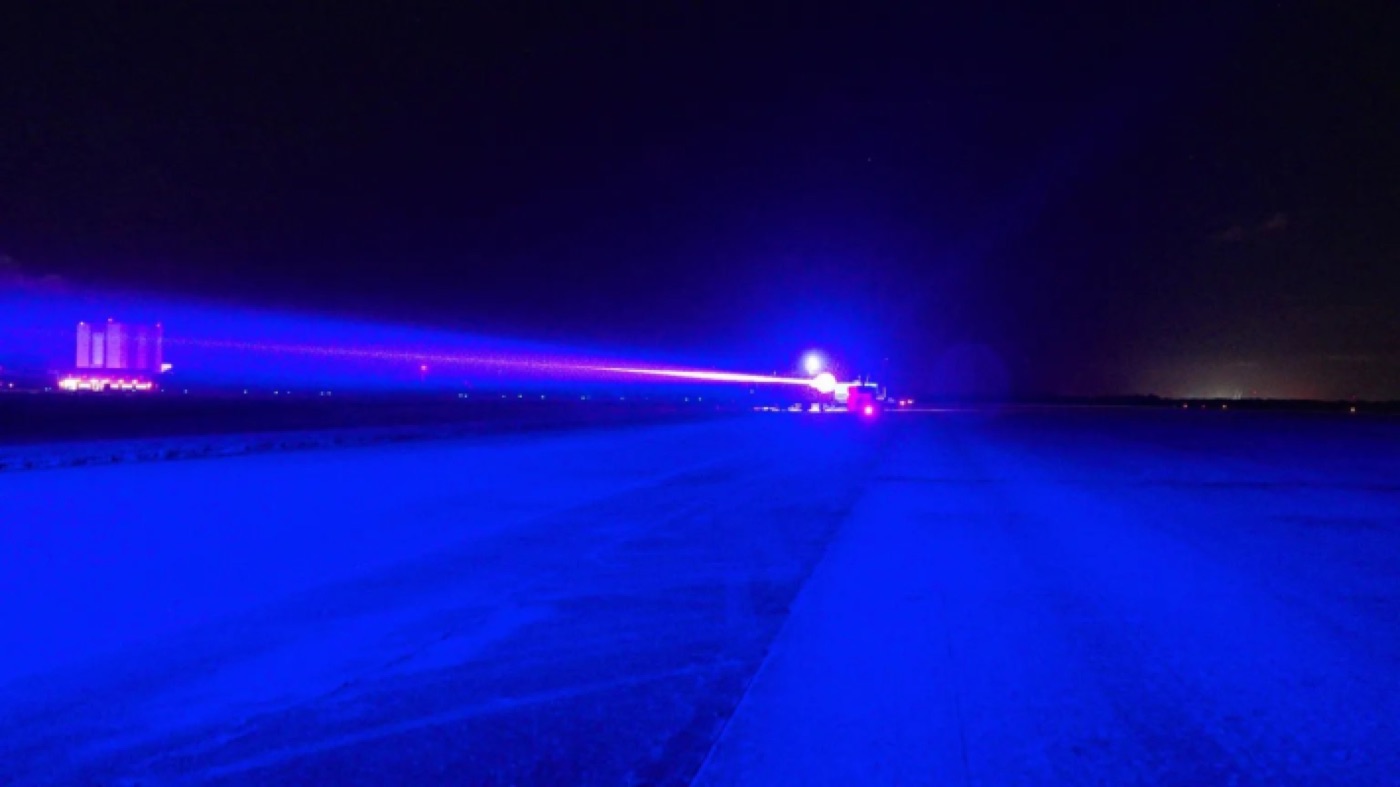
- November 2025: test campaign at Kennedy Space Center and Space Florida's Launch and Landing Facility. Multi-wavelength lasers this time. Over 1.1 kW delivered to commercial solar panels, beating DARPA's 800 W record set six months earlier. More than 10 megajoules delivered across the campaign, including to live customer payloads from the data-center, in-space manufacturing, and remote sensing segments
- May 2026: $65M oversubscribed Series A led by B Capital, co-led by Shield Capital and Cerberus Ventures. $88M raised in total. Roughly 40 employees.
- Late 2026: first on-orbit demonstration. A second mission already in build
Late 2026: first on-orbit demonstration. A second mission already in build
Note the pivot between March and November: sunlight to lasers. The stadium demo proved the concept was real. The Kennedy campaign proved the concept could be engineered. Those are different claims, and the company made them in the right order.
04The architecture: 200 power nodes
The planned constellation is roughly 200 satellites, Star Catcher calls them power nodes, at about 1,500 km altitude, above the main LEO shells where most customers fly
Each node is 15 to 20 meters on a side. Mostly optics: a large collector to gather sunlight, conditioning stages, a laser transmitter assembly, and a pointing system. A single node can deliver anywhere from 100 watts to 100 kilowatts, sized to the client
Three architectural choices define the whole business:
No atmosphere intervention: Star Catcher beams orbit-to-orbit only. Never to the ground. Air absorbs, scatters, and turbulently distorts an optical beam, it also brings weather, regulators, and the political question of who is allowed to point a megawatt-class laser at a country
No retrofit: The receiver on the client satellite is the solar array it already has. This is the single most commercially important decision the company has made, and section 5 explains why it works
They sell power, not hardware: Star Catcher owns and operates the nodes. Customers sign power purchase agreements and pay as they go, the utility model, imported to orbit
Sitting above the customer shell has a quiet benefit too, a higher orbit means longer sightlines, more customers visible per pass, and a slower relative geometry to track.
05How 'charging' actually happens
Two pieces of physics carry this whole company:
1- The beam: why the aperture is the product
Light spreads, A perfectly collimated beam is a fiction, diffraction guarantees that any beam leaving an aperture of diameter D at wavelength λ diverges at an angle of roughly θ ≈ λ/D. Over a distance L, the spot arriving at the far end has grown to about L·λ/D
Run the numbers and the design logic falls out immediately. At a 1-micron wavelength over 1,000 km, an aperture of 1 meter gives you a spot roughly a kilometre wide. Almost all of that energy misses a solar array that is a few metres across. Make the aperture 10 meters and the spot shrinks to about 100 metres. Make it 20 and you are down to tens of meters, the same order as the target
That is why the nodes are 15 to 20 meters on a side. The aperture is not a design detail, it is the product. Every metre of collector diameter buys range, and range buys the number of customers one node can serve, and that is the entire unit economics of the constellation
Then there is pointing. A 20-metre aperture at 1,000 km is aiming at something like a microradian of angular precision — holding a beam steady on a solar panel while both spacecraft move at 7.5 km/s in different orbital planes. This is the hardest unsolved thing Star Catcher does, and it is precisely what the ground demos could not prove. A stadium does not move.
2-The silicon: why the sun is the wrong color
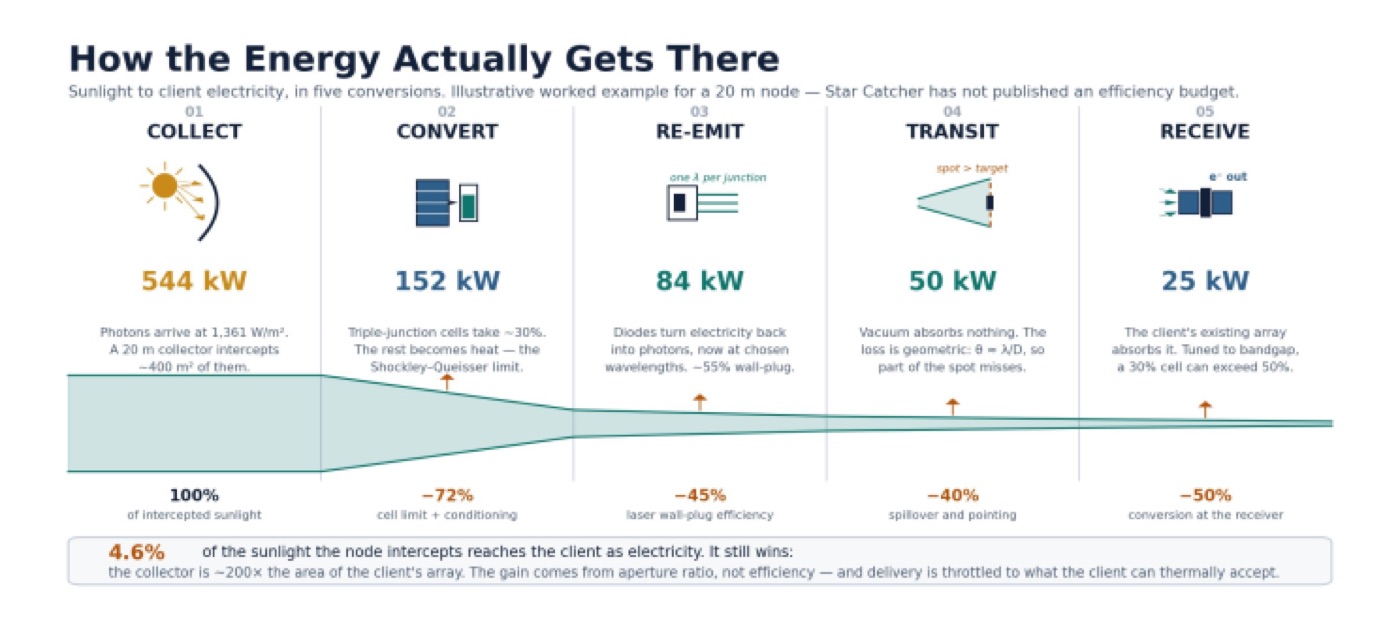
A solar cell is not a heat engine. It is a quantum device with a threshold. A photon with less energy than the cell's bandgap passes through and does nothing. A photon with more energy than the bandgap does create an electron, but the surplus energy is dumped as heat rather than current
Sunlight is a broad spectrum, from ultraviolet through visible into infrared. Against any single-junction cell, most of that spectrum is wasted at one end or the other. This is the Shockley–Queisser limit, and it caps a single-junction silicon cell near 33% efficiency. Space-grade triple-junction cells stack three materials with three different bandgaps to catch three slices of the spectrum, and reach the mid-30s in practice
Now here is the thing, If you get to choose the color of the light, you are no longer bound by the sun's spectrum. Tune your laser to sit just above the bandgap of the cell you are illuminating and nearly every photon lands in the sweet spot: enough energy to lift an electron, not so much that the excess becomes waste heat. Cells that manage 30% under sunlight can exceed 50% under monochromatic light matched to their bandgap
Star Catcher used multiple wavelengths at Kennedy for exactly this reason, a triple-junction cell has three bandgaps, so you feed it three colours, one per junction. They gather broad, messy sunlight, and re-emit it as light the receiver was accidentally optimised for
This is what makes "no retrofit" possible, and it is genuinely clever. The customer's existing hardware becomes a better receiver than it ever was as a solar panel. The company's stated result: one to ten "suns" of delivered intensity, translating to two to ten times the power the client could generate alone
06What Star Catcher unlocks
1- Continuous operation: A satellite in low Earth orbit spends up to 40% of every 90-minute pass in Earth's shadow, running on battery. A power node in a higher, sunlit orbit can cover the eclipse. Duty cycle goes from partial to near-continuous, which for a compute payload is the difference between a demo and a product
2- Smaller buses: If power arrives as a service, you do not need to build a satellite around an oversized array. Star Catcher's own framing: a 100-watt bus becomes 1 kW-capable, and a typical 1,000–1,500 W bus jumps to roughly 15 kW. Astro Digital's Corvus Micro, a small, cheap, already-flying platform, could run a GPU at full duty cycle. That inverts the design process. Instead of sizing the mission to the power you can carry, you size the power to the mission you want
3- Orbital data centers: This is the segment everyone points at, and it deserves precision rather than excitement. The bottleneck for space compute is not launch and it is not only chips. It is watts and heat. Star Catcher addresses the first half: a 15 kW bus is roughly a quarter of a datacenter rack at high uptime, which is small but is not a toy
More importantly it converts a capital problem into an operating one. A compute startup no longer has to finance its own generation infrastructure before it earns a dollar, it can rent power and scale with demand. Starcloud and Astro Digital have both signed PPAs
4- In-space manufacturing: Furnaces and crystal growth are energy-hungry and duty-cycle-limited, which is the exact shape of problem beamed power solves. Rush and Snyder come from this world, which is presumably not a coincidence.
5- Defense: This may be the near-term revenue story rather than a footnote. Agile maneuvering, high-power sensing, and electronic warfare are all power-limited. Beamed power also decouples a spacecraft's capability from what was launched inside it, a satellite can be quietly upgraded in place, and a constellation's power can be reallocated to whichever asset matters this week. Star Catcher started with an AFWERX SBIR, took investment from Shield Capital and Cerberus, and put General Jay Raymond, the founding Chief of Space Operations, on its board with the Series A. That is not a passive cap table. It is a company telling you where it expects its first large contracts to come from
07Who buys, and how the money works
Star Catcher had signed seven power purchase agreements as of May 2026 publicly Starcloud (orbital data centers), Astro Digital (satellite owner-operator) and Loft Orbital (flexible satellite infrastructure), alongside multiple undisclosed government customers, a partnership with Satlyt for in-orbit data processing, and over 30 letters of intent. In November 2025 the company described six of those agreements as collectively worth tens of millions of dollars in annual recurring revenue through the end of the decade. During the Kennedy campaign, customer payloads from the data-center, in-space manufacturing and remote-sensing segments ran live on beamed power
Orbital compute is the segment most likely to buy first, and the numbers show why. A single NVIDIA H100 draws about 700 W, or roughly 1 kW once supporting components are counted, while the average satellite in orbit generates on the order of 1 kW in total, shared across radios, attitude control, thermal and avionics before any payload is served. Starcloud-1, launched November 2025 on an Astro Digital Corvus Micro bus, carried the first data-center-class GPU into orbit. Star Catcher's published analysis puts that bus near 100 W peak and infers a duty cycle below 10%; other accounts describe the array as closer to 1 kW. It is a tenfold disagreement, unresolved, and the lower figure comes from the party selling the remedy
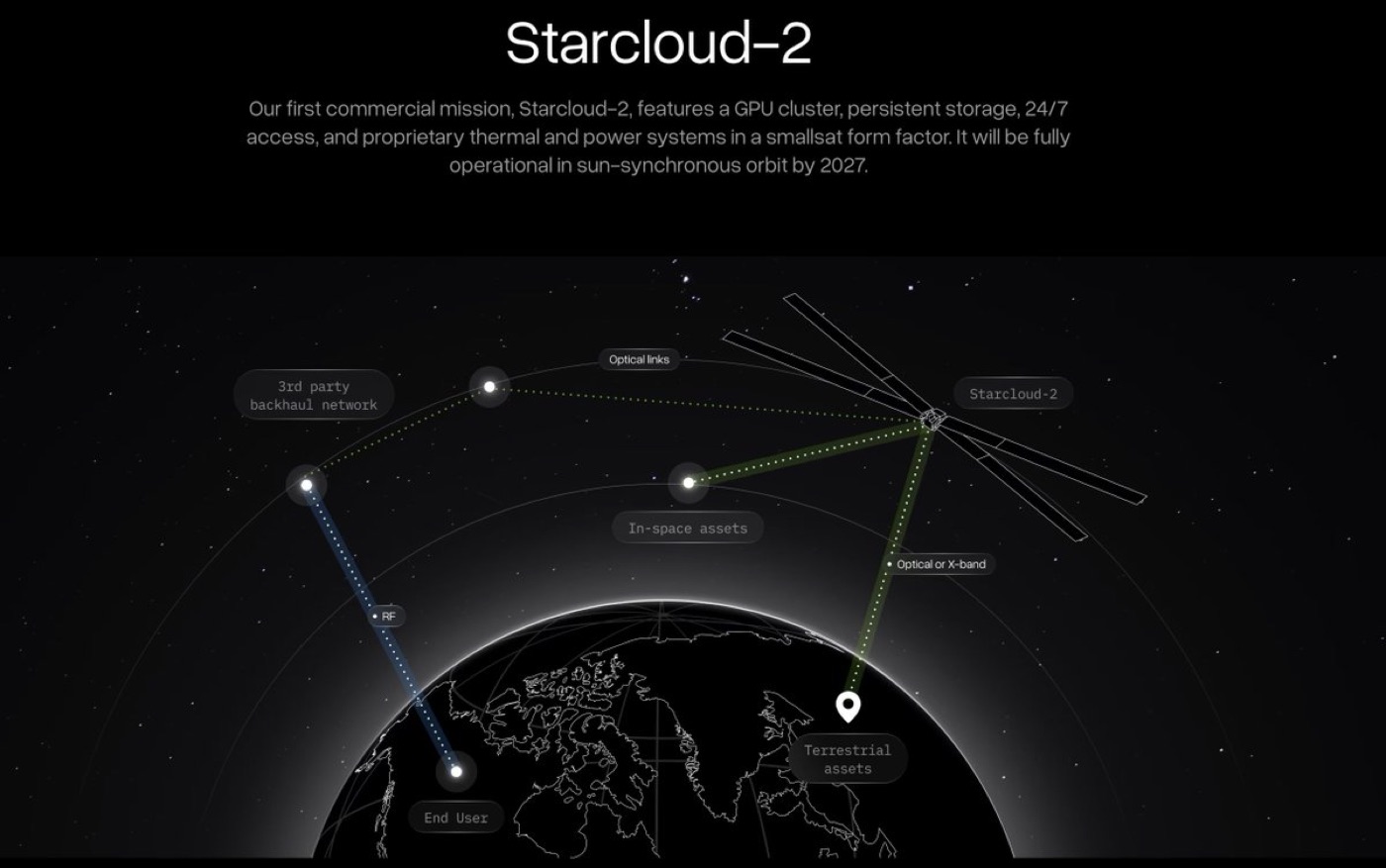
On supply, Starcloud is doing both. It builds its own arrays as the primary source, about 7 kW on Starcloud-2, roughly 100,000 m² and 400 tonnes for its 40 MW target, a four-kilometer array for the 5 GW ambition, while holding a PPA with Star Catcher that both parties describe as accelerating deployment rather than replacing onboard generation. The arithmetic explains that framing. Two hundred nodes at up to 100 kW each is a 20 MW nameplate ceiling for the entire constellation: about 20,000 H100s, 167 GB200 racks, or half of one planned 40 MW data center. Beamed power is a bridge for the kilowatt-to-tens-of-kilowatts era, not a substitute for self-generation at gigawatt scale, and in either case it moves the supply curve only, since every delivered kilowatt still has to leave as heat through radiators the spacecraft already carries
Pricing is not public, so the honest version of the economics is structural rather than numeric
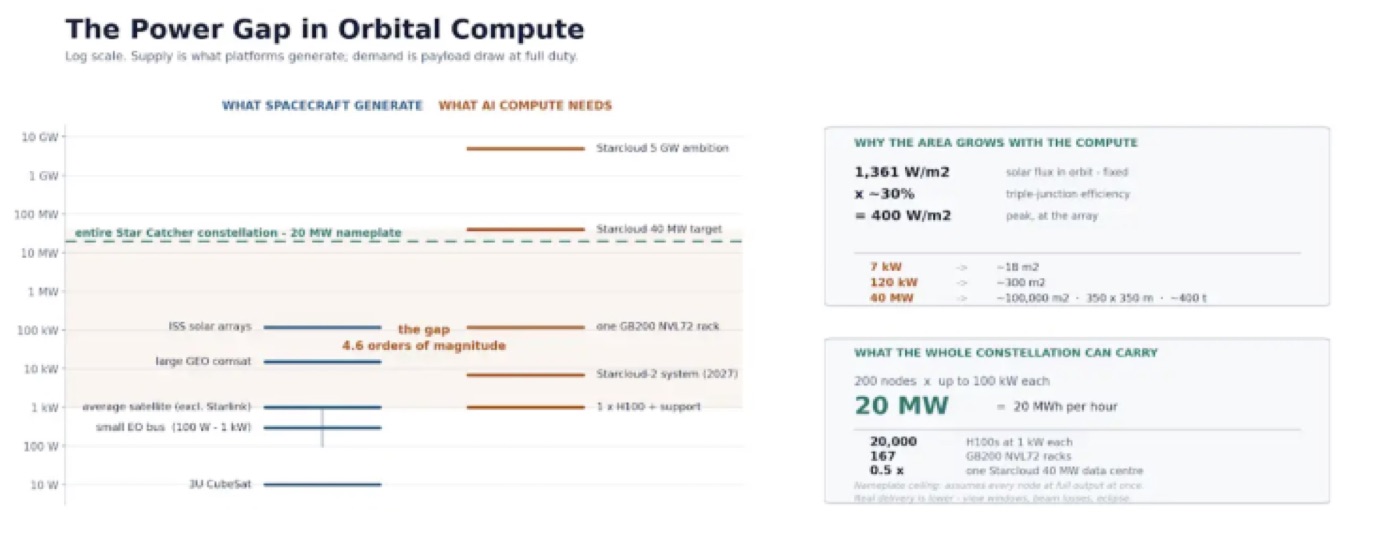
On the customer's side, the comparison is not "power versus no power." It is rented power versus a bigger satellite. Doubling a spacecraft's array means more mass, more volume, more deployment risk, and a larger bus, costs that compound and are paid up front, years before launch, against a demand forecast made when the mission was still a slide. Beamed power replaces that with a bill that arrives after the capability does. For a startup that is the difference between raising a Series C and not
On Star Catcher's side, the business is a utility with an unusual cost curve. The fuel is free and unlimited. The nodes are the entire capital base, and once one is up, marginal cost per delivered joule is close to zero — bounded by pointing time, not by resources consumed. Revenue per node scales with how many customers it can reach and how much of the time it is serving one, which loops straight back to aperture, orbit and slew rate. That is a rare shape: a business whose unit economics are set almost entirely by optical engineering
The uncomfortable part is the order of operations. Utilities are wonderful once built and brutal to build. Roughly 200 nodes of 15–20 meter optics is a serious capital program, and $88M does not fund it, it funds the proof that it is fundable. The Series A buys two demonstration missions. The infrastructure round comes after, and it will be large
08Future challenges to look into
Thermal, on the receiving end: A client's solar array was designed for one sun. Deliver ten and the array is absorbing several times the energy it was ever qualified for, and whatever it does not convert becomes heat that has nowhere to go except radiators the satellite does not have. "No retrofit" is a brilliant commercial claim, but it puts the thermal burden on hardware the customer already flew and Star Catcher does not control. Expect real caps per client, well below the headline multiple, and expect the honest answer to be mission-specific
Cell degradation: Space solar cells are rated for a known lifetime dose of sunlight and radiation. High-intensity monochromatic illumination over years is not that environment. It may be fine. Nobody has a decade of data
Starcatcher is on our radar at Starcap and we think that the company will act as an incredible piece of infrastructure that will empower the whole industrialization of the low earth orbit, and beyond