
Why the most important factories of the 2030s might not be in Taiwan or Arizona, but in orbit
Semiconductors are the largest, most strategic manufactured product on Earth. The industry crossed its highest sales year ever in 2025, and forecasts for 2026 cluster around $1–1.3 trillion, years ahead of schedule
One force, as we all know, pulled the timeline forward: AI. Training and running AI models consumes chips faster than the world can make them, and AI-related silicon now accounts for roughly half of industry revenue while representing a tiny fraction of unit volume
In other words: a small number of extremely advanced, extremely expensive chips are now the center of gravity of a trillion-dollar market, and that's why $NVIDA and $TSMC stocks been ripping for the past 5 years
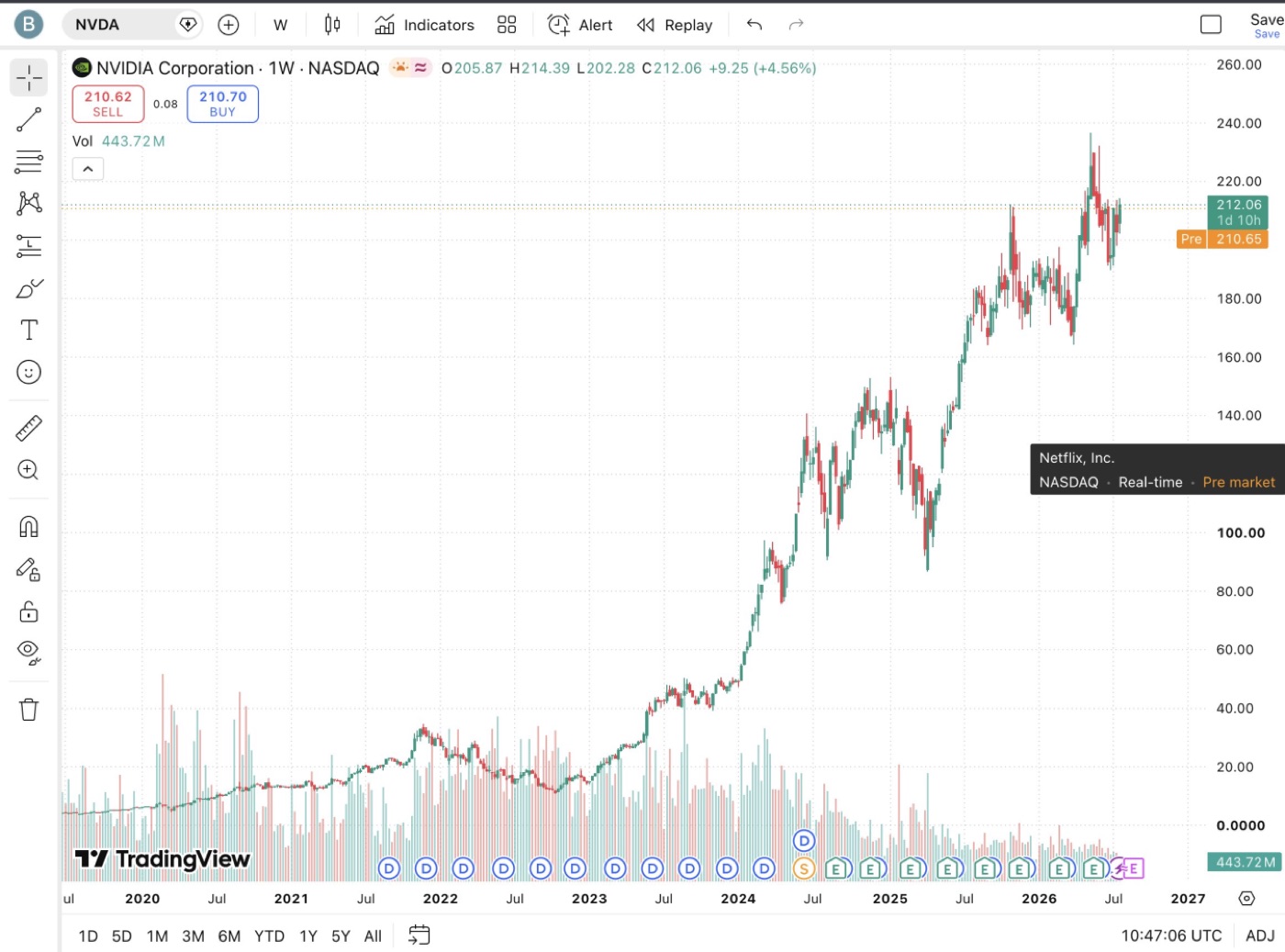
and that's exactly where the problems live
Who runs the show today
One company sits at the center of it all:
TSMC The Taiwanese foundry manufactures roughly 90% of the world's most advanced chips, including virtually every AI accelerator NVIDIA sells, and it earned that position through a simple, brutal flywheel: it doesn't design chips or compete with its customers, so everyone (Apple, NVIDIA, AMD, Qualcomm) trusts it with their crown jewels. that flood of orders funds the biggest R&D and capex budget in the industry, and that budget keeps its manufacturing a step ahead of Samsung and Intel
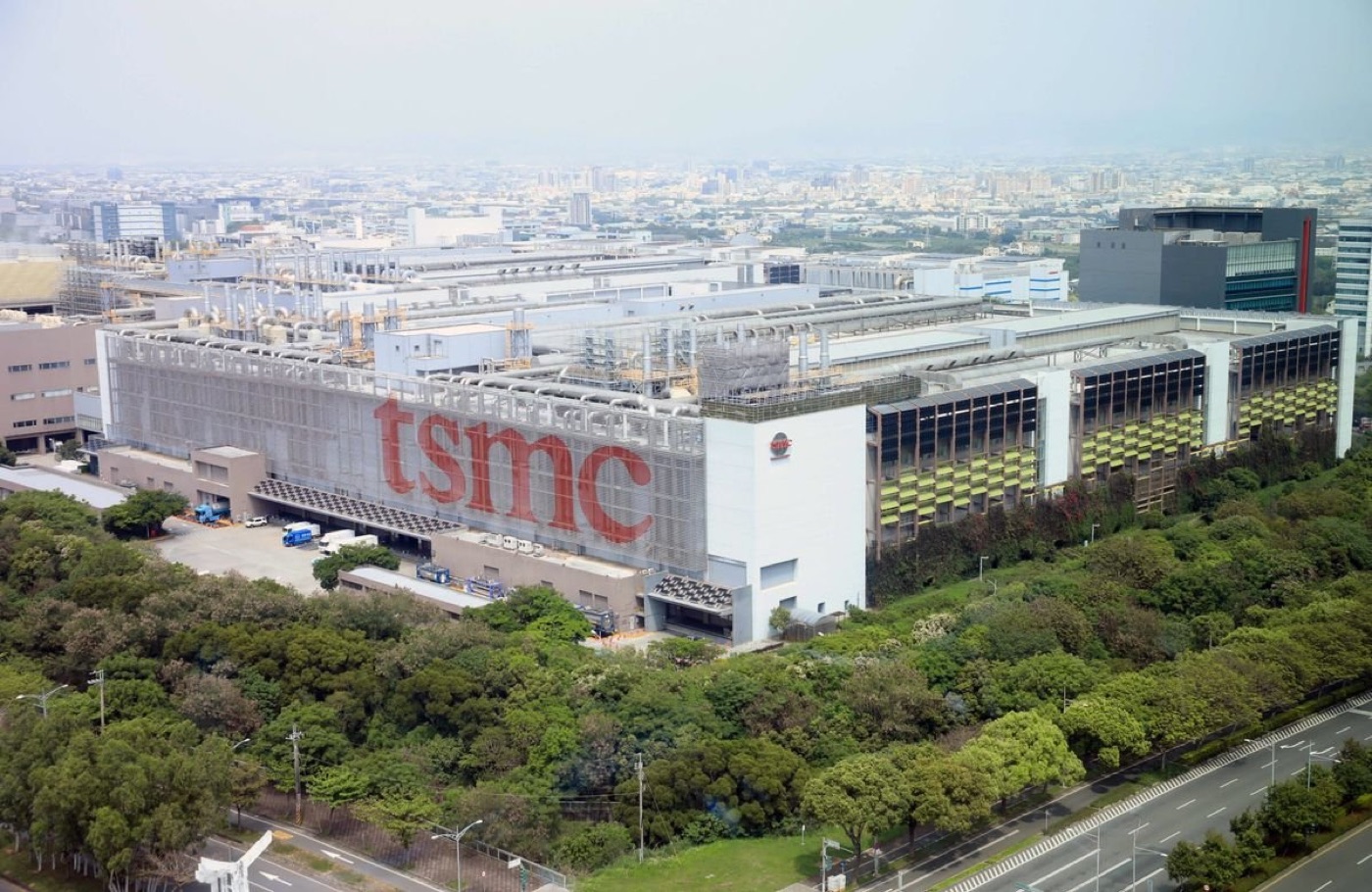
But notice what TSMC's dominance is built on: mastering manufacturing on Earth, squeezing ever-smaller circuits out of the same material, silicon, inside the same environment, gravity. It is the best in the world at a game whose board is starting to reach its edges. but we are ready for what's next
We're running into engineering, not physics problem
Three bottlenecks matter:
1-Materials are hitting their ceiling
Silicon, the workhorse of every chip since the 1960s, is close to its physical limits in power efficiency and heat tolerance. The next generation of materials (gallium nitride, silicon carbide, ultimately synthetic diamond) can run hotter, faster, and waste far less energy, exactly what power-hungry AI data centers need. But they are brutally hard to grow as clean crystals on Earth, for reasons that come down to gravity itself (more on that below)
2- Defects kill yield
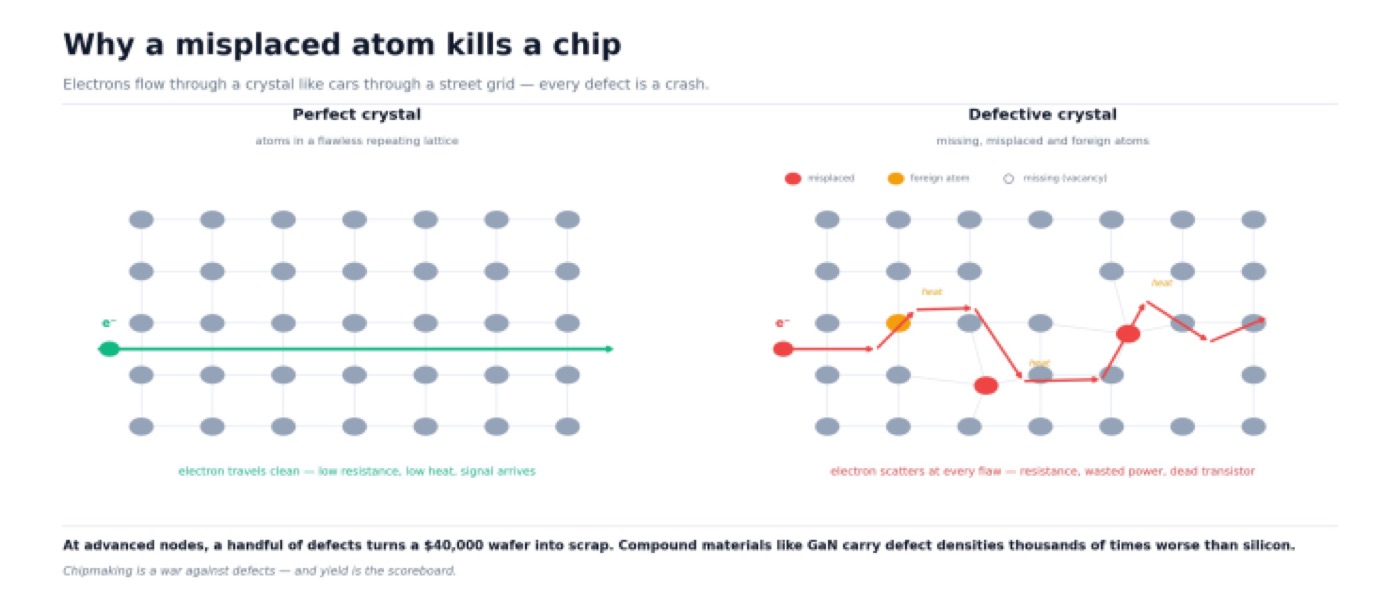
A chip is built on a wafer sliced from a single crystal, billions of atoms that must stack in a near-perfect repeating pattern. Every misplaced atom is a defect, and at advanced nodes a handful of defects can turn a $40,000 wafer into scrap. Compound materials like GaN suffer defect densities thousands of times worse than silicon, which is a big reason they remain niche and expensive
3-Fabs are absurdly expensive
A single leading-edge fab now costs $20B+, takes years to build, and much of that money buys one thing: fighting the environment, vacuum pumps, cleanrooms, vibration isolation, contamination control
We spend billions recreating, imperfectly, conditions that exist naturally somewhere else. funny right?
Gravity is the enemy of a perfect crystal
Let's start with what a chip actually is. Underneath the circuits, every chip is built on a slice of a single crystal, one continuous, repeating lattice of atoms, like scaffolding that must be flawless for billions of layers. Electrons flow through this lattice the way cars flow through a perfect grid of streets. Every atom that's missing, misplaced, or foreign is a pothole: it scatters electrons, leaks current, generates heat, and at worst kills the transistor sitting on top of it. Chipmaking is, at its core, a war against defects, and gravity is on the side of the defects
Here's how gravity disturbs this:
1. Gravity stirs the pot (convection)
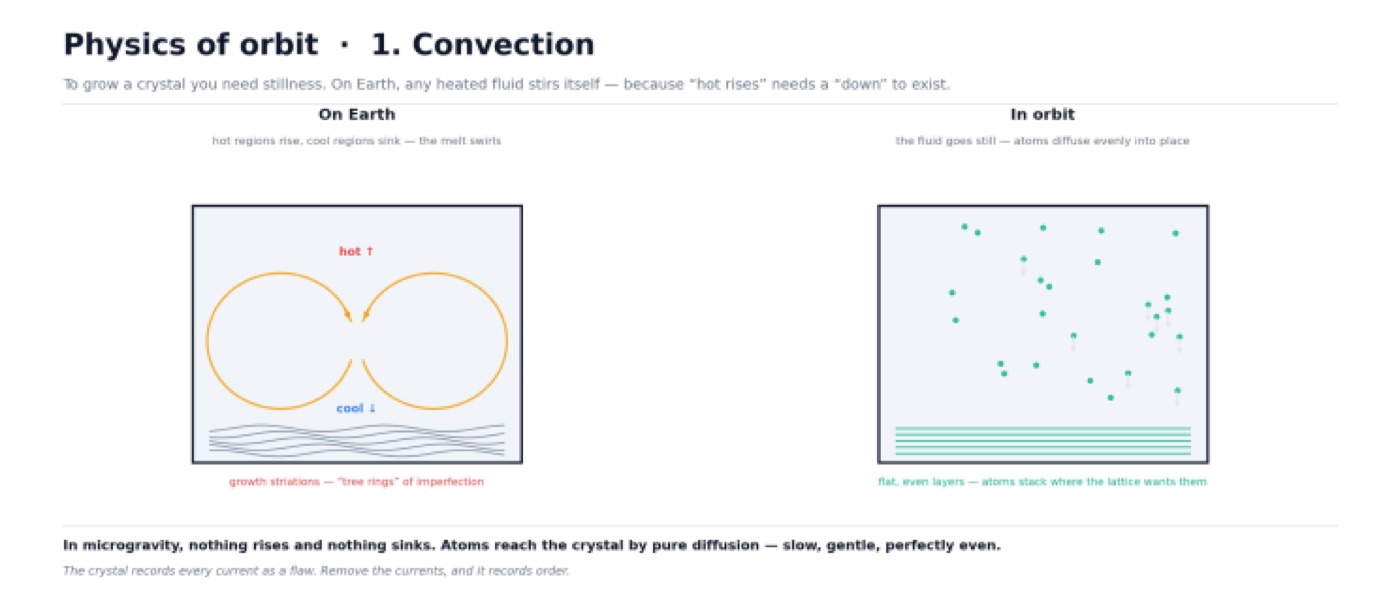
To grow a crystal, you either cool a molten material slowly or deposit atoms from a hot gas onto a surface, one layer at a time. Both need stillness. But on Earth, any fluid with a temperature difference stirs itself: hot regions are less dense, so they rise, and cool regions sink
This is convection, the same reason a radiator heats a whole room. Inside a crystal furnace, these invisible currents constantly swirl the melt or gas, dragging atoms past the growth surface at uneven speeds. The crystal records every fluctuation as a flaw, visible under a microscope as striations, literally growth rings of imperfection, like tree rings you never wanted
In microgravity, "hot rises" simply stops being true, because rising requires a down. The fluid goes still. Atoms reach the crystal by pure diffusion, a slow, gentle, perfectly even random walk, and stack where the lattice wants them. Decades of experiments, from @NASA's Skylab in the 1970s to the ISS, confirmed the effect: crystals grown in microgravity come out more uniform and more ordered than their Earth-grown twins
2. Gravity sorts the atoms (sedimentation)
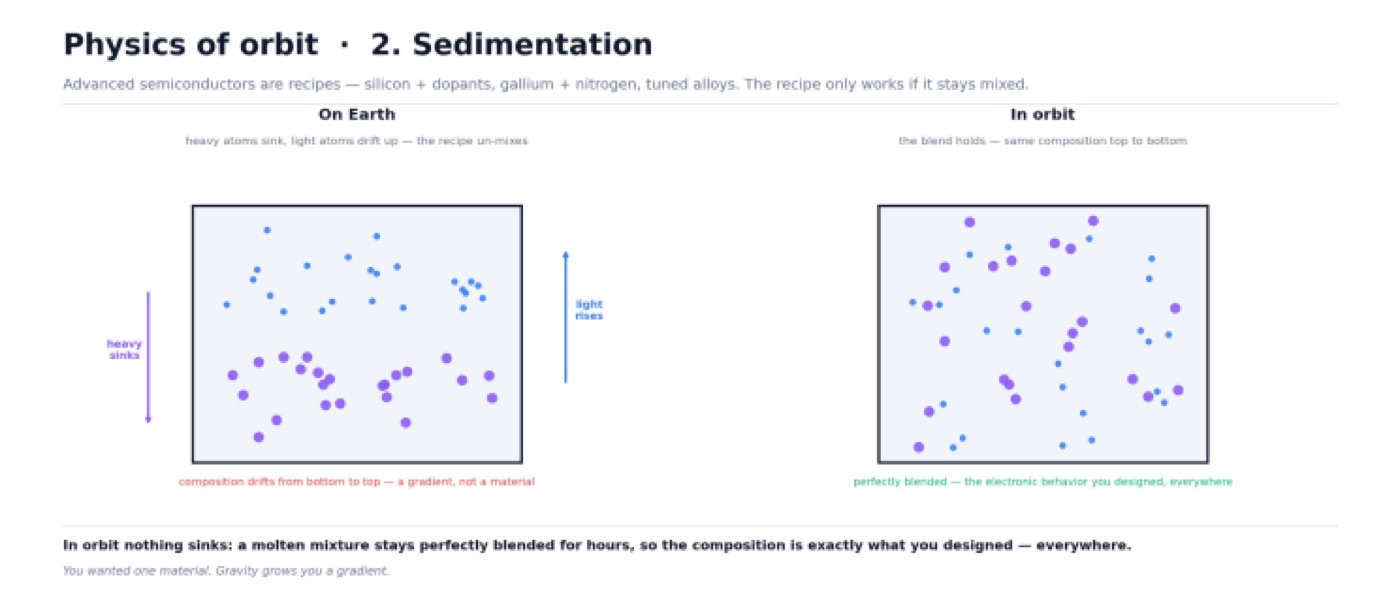
Advanced semiconductors are recipes: silicon doped with phosphorus, gallium bonded to nitrogen, alloys with precisely tuned compositions. On Earth, heavier atoms slowly sink and lighter ones drift up while the mixture is molten, so the recipe changes from the bottom of the crystal to the top. You wanted one material, you grew a gradient
But in orbit, nothing sinks. A mixture stays perfectly blended for hours, and the composition, which sets the material's electronic behavior, stays exactly what you designed, everywhere in the crystal
3. Gravity forces contact (containers)
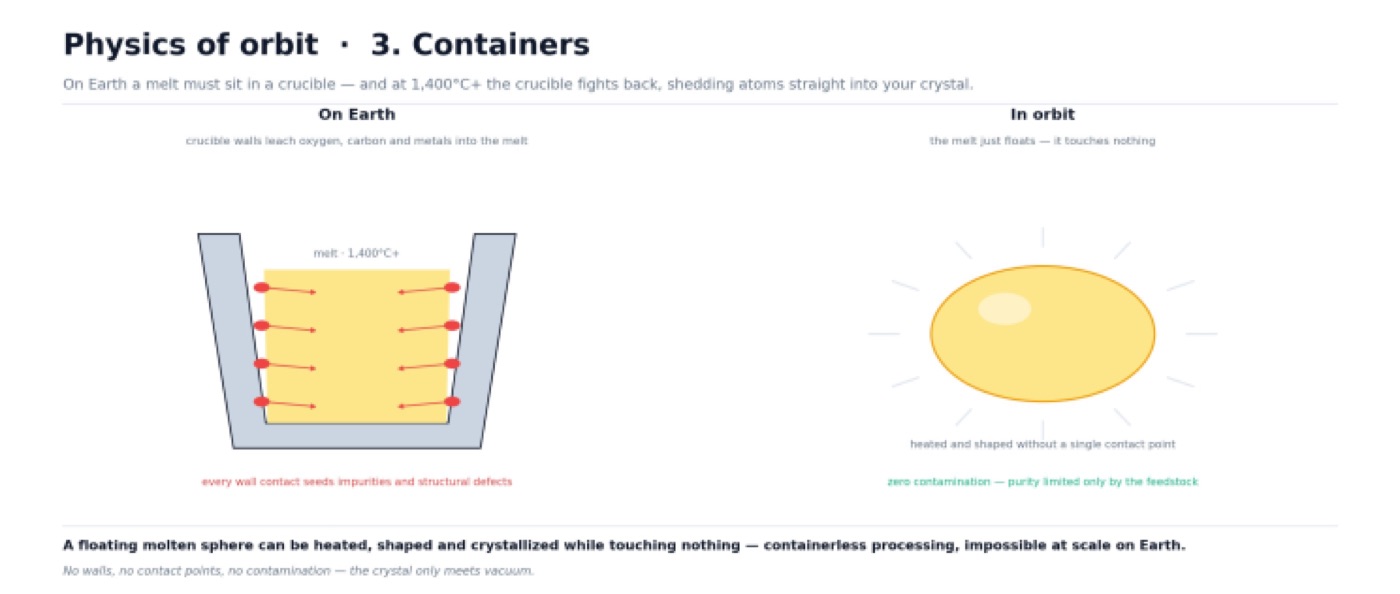
A melt on Earth must sit in a crucible, and at 1,400°C+ the crucible fights back: its walls leach oxygen, carbon, and metal atoms straight into your crystal, and the contact points seed structural defects
But in orbit, a molten sphere just floats. You can heat it, shape it, and crystallize it while it touches nothing, containerless processing, which is essentially impossible at scale on the ground
4. Space is the cleanroom (free ultra-vacuum)
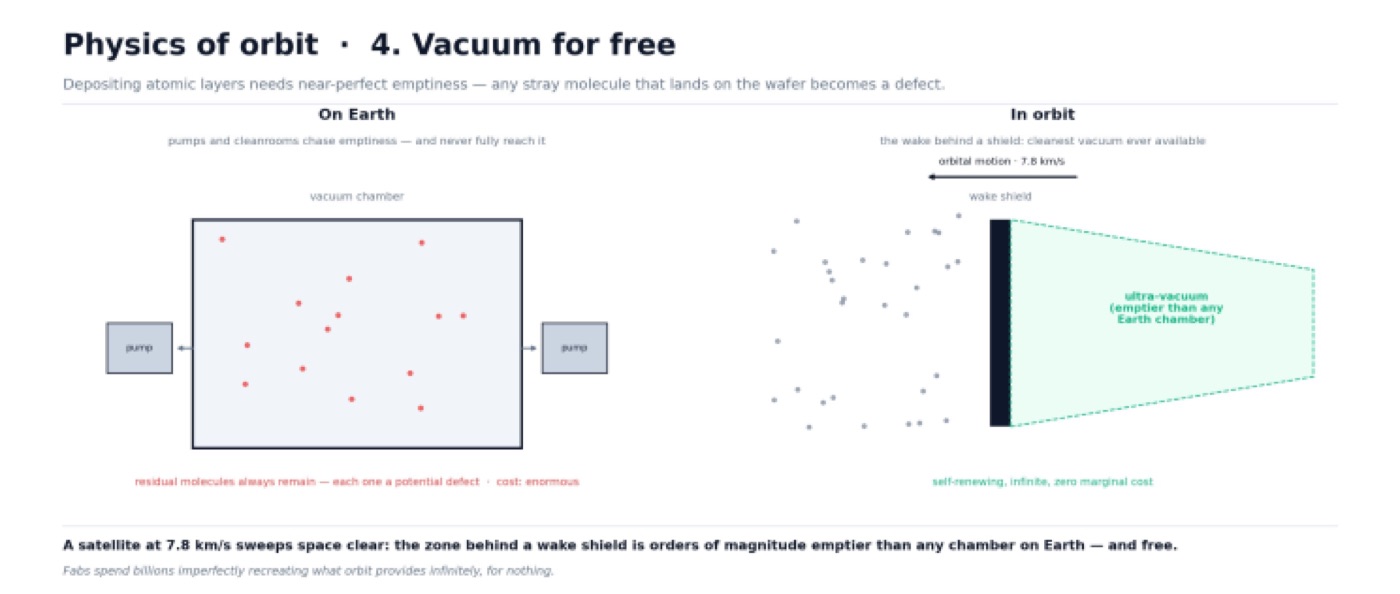
Depositing atomic layers requires near-perfect vacuum, because any stray molecule that lands on the wafer becomes a defect. Fabs spend enormous sums on pumps and cleanrooms chasing this emptiness and never fully reach it.
But orbit is the definition of emptiness. Better still, a satellite moving at 7.8 km/s can deploy a simple plate, a wake shield, and the zone behind it, swept clear like the calm water behind a speedboat, is orders of magnitude emptier than the best vacuum chamber ever built on Earth. Infinite, self-renewing, and free
Why this matters most for the new materials? What makes a semiconductor useful is its band gap, the energy jump an electron makes when the material switches. Silicon's band gap is modest, which is why silicon chips leak power and struggle with heat. Gallium nitride's band gap is about three times wider, silicon carbide's similar, diamond's wider still, meaning devices that switch faster, handle higher voltages, and waste dramatically less energy
That's precisely what AI data centers, fast chargers, EVs, and radar are starving for. The blocker has never been the physics of these materials, it's that we can't grow them cleanly. GaN crystals grown on Earth carry defect densities millions of times higher than silicon, because they usually have to be grown on top of a foreign material whose atomic spacing doesn't match, and gravity-driven turbulence makes the mismatch worse
Space attacks this exactly where it hurts: stiller growth, purer feedstock, no container, perfect vacuum. @Space_Forge 's stated result target: crystals hundreds to thousands of times purer than ground-grown equivalents. You don't need many of them, a thumb-sized space-grown crystal can serve as the seed from which Earth factories pull thousands of high-quality wafers, spreading its perfection downstream
Who's building it
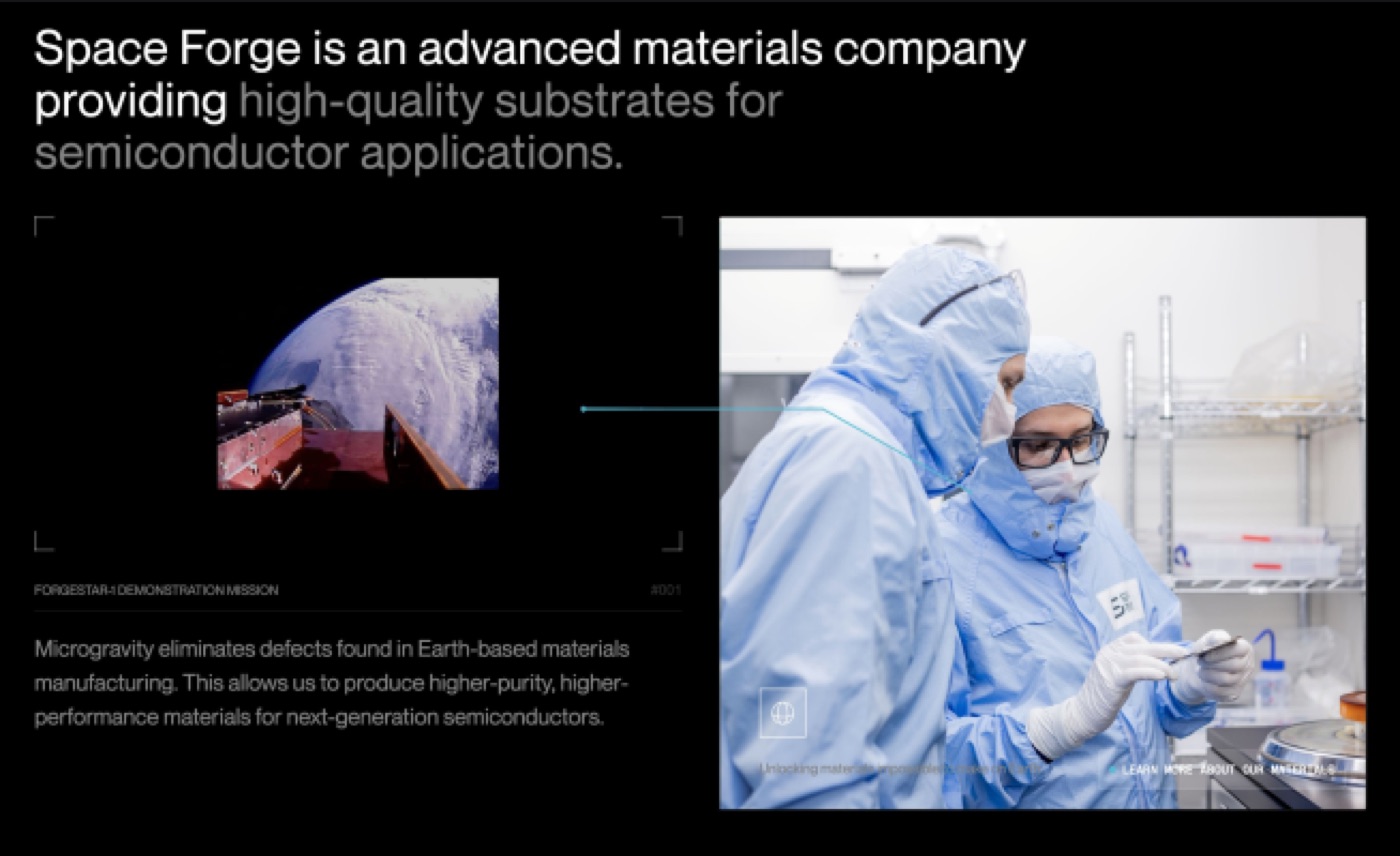
Space Forge (UK), the furthest along. Its ForgeStar-1 satellite, launched June 2025, generated plasma in orbit in December, the first free-flying commercial semiconductor manufacturing tool ever operated in space ForgeStar-2 adds a reentry heat shield to bring the first space-made materials home, then process them into wafers on the ground. Target: one production system feeding material for ~10 million semiconductors
Astral Materials (US), Stanford-born, NASA-backed. Building microgravity crystal-growth furnaces focused on GaN and ultra-pure silicon, with a demonstration mission (COSMIC, with SpaceWorks) slated to grow silicon crystals in orbit and return them in 2027
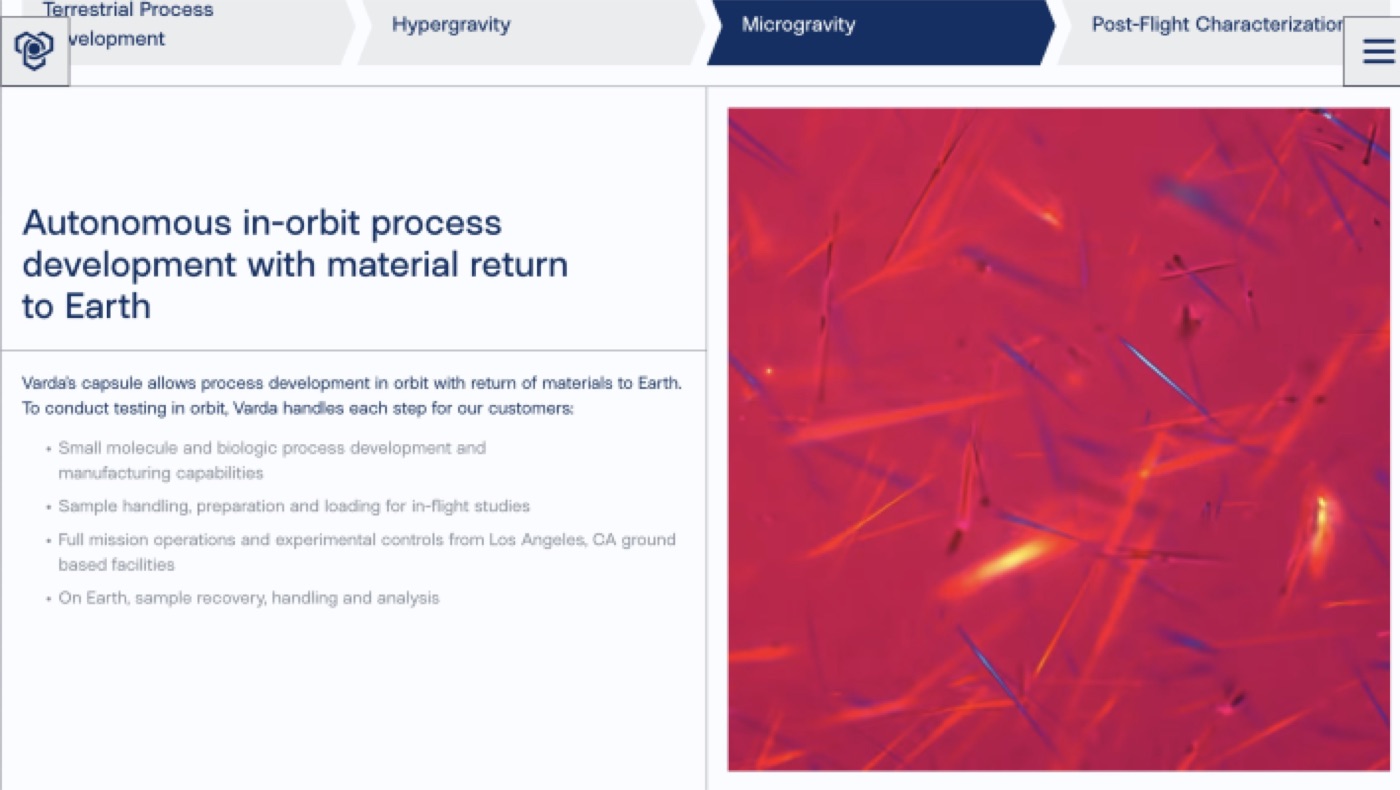
Varda Space Industries (US), the platform play. Over $300M raised, multiple successful orbit-and-reentry missions already flown (starting with pharmaceuticals). Varda proved the hard part, autonomous manufacturing in orbit plus routine reentry, and that capability generalizes to any high-value material, chips included
The economics, and where the opportunity is
The math only works for one category of product: extremely high value per kilogram
You can't launch cars or steel., but a semiconductor substrate is featherweight and worth thousands of dollars, a single kilogram of finished GaN or diamond wafer material can carry six-figure value. When launch costs are falling toward $1,000/kg and heading lower, and one small capsule can return material for millions of chips, the freight bill becomes a rounding error on the product value
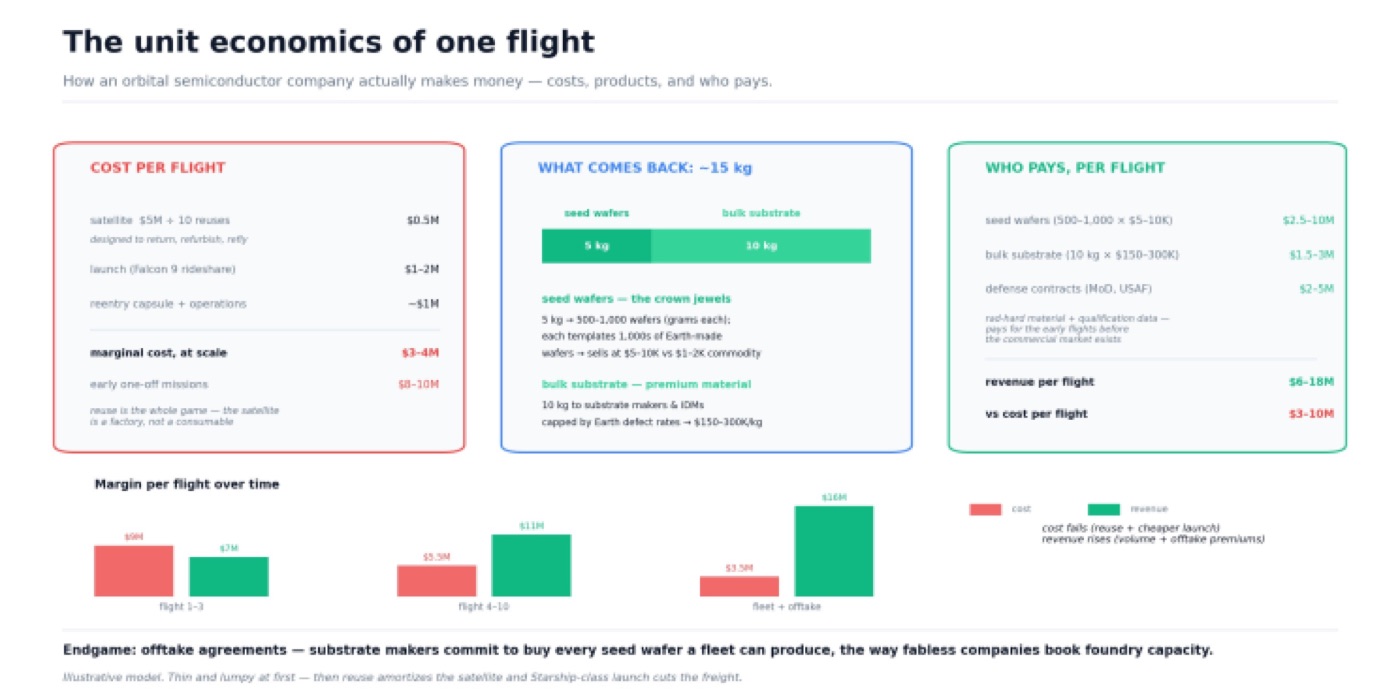
To make it practical, walk through one flight of a company like Space Forge. The satellite costs ~$5M but is reusable, amortized over ten flights, plus a Falcon 9 ride share ($1–2M) and reentry ops, a flight's marginal cost settles near $3–4M ($8–10M for early one-offs). It returns ~15 kg of ultra-pure GaN: 5 kg sliced into 500–1,000 seed wafers at $5–10K apiece, each one a template Earth factories copy across thousands of ordinary wafers. plus ~10 kg of bulk substrate at $150–300K/kg Defense contracts (UK MoD, US Air Force) add $2–5M per mission and fund the early flights before the commercial market matures. Net: $6–18M of revenue against $3–10M of cost, thin at first, then structurally widening as reuse and cheaper launch cut costs, with the endgame being offtake agreements: substrate makers committing to a fleet's entire seed output, the way fabless companies book foundry capacity. At that point the company isn't selling crystals, it's selling certainty of supply for a material nobody else can make
Taiwan built it's whole economy on 1 single industry, and i wonder what kind of new economies will be unlocked by the niche use-cases in the space sector that can somehow translates into millions of working nations with trillions of value generated.
Time will tell, and Starcap will be ready for it