Over the last decade, frontier markets have pushed us towards investing in innovation since naturally, that is where the value always goes towards. In fact, in the course of history, this is always how every new sector has brought about a huge gold rush for the entire economy.
Railways went first. Track was laid across Britain and America from the 1840s through the 1870s, and the capital chasing it financed the industrial economy that came after. Electrification and the automobile repeated the pattern in the 1920s. Television reached most American homes during the 1950s. Personal computing built Microsoft and Apple through the late 1970s and 1980s.
30-40 years ago we had the commercial internet, and the dotcom bubble that came with it a decade later, with the likes of Google and Amazon being born.20 years ago it was social media, with Meta (Facebook) with a decade of changing how people interact on the internet creating the social layer for attention which has continued to evolve over the years and even leads me to write this article where you're reading it today.
15 years ago it was crypto, Bitcoin first before Ethereum and others innovated on the programability of finance. Then Artificial intelligence, with OpenAI in 2015 and Anthropic in 2021, in 2022 everything changed with chatGPT, at the time being the fastest growing consumer product in the world. Robotics, Biotech, Quantum and many other sectors are going through this era right now.
Over the last few years, one sector particularly has grown from strength to strength and itll be the core of this article Im writing, yes, its space! Most people still file space under science fiction, or under billionaires with expensive hobbies. That reading is about a decade out of date. We already have reduced the cost of going to orbit by a factor of 100x in 60 years, hundreds of launches every year, and some of the highest revenue businesses in the world are already in space.
All of this has already happened.
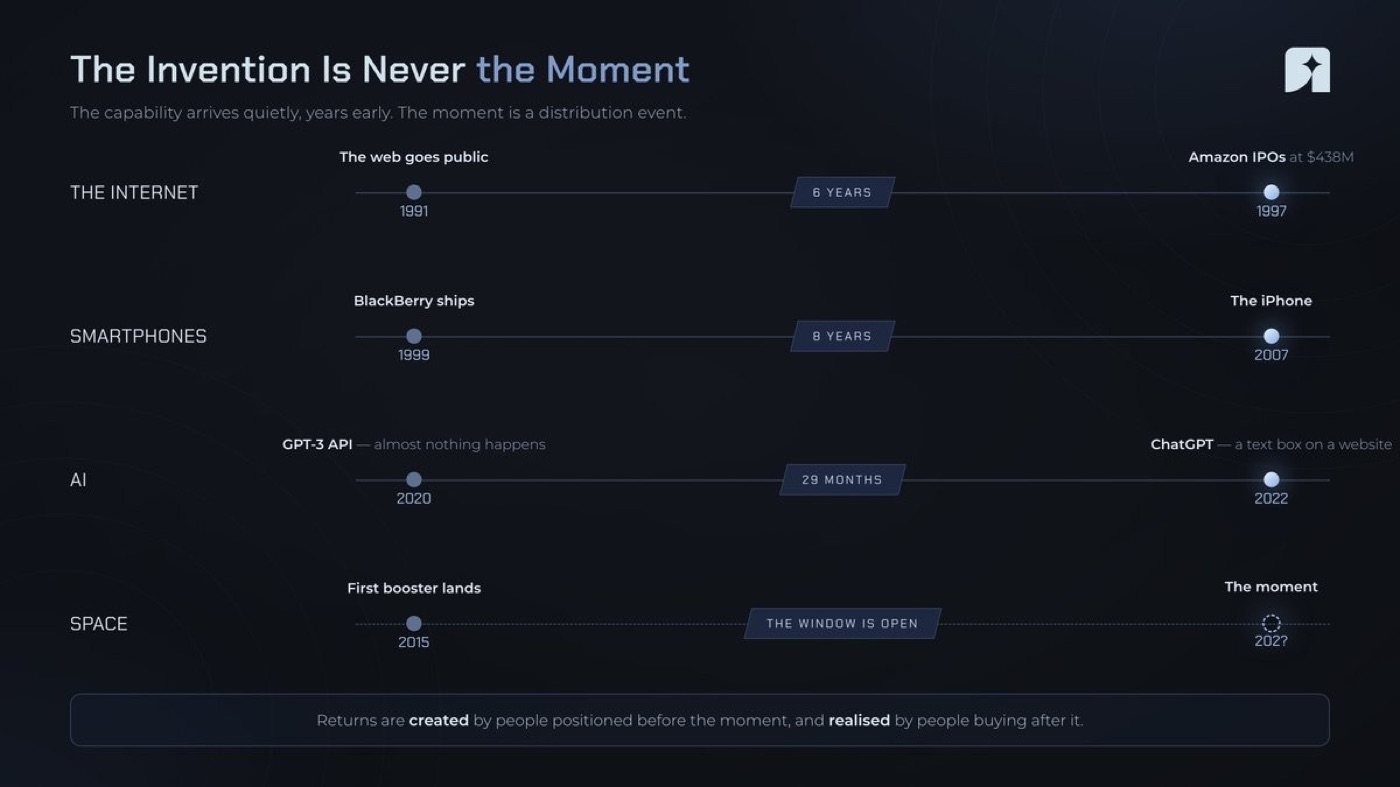
What has not happened yet is the moment this becomes obvious to everybody else. What strikes me about the above list is how little the technology itself explains the timing. In almost every case the core invention existed for years before the money arrived. What changed was the cost of using it. Once that cost fell far enough for ordinary businesses to build on top, capital moved, and it moved quickly! That moment for me arrives inside the next few years for space. This article is about why, what has to be true for it to happen, and where I believe the value ends up within the space economy.
I want to be precise about what I mean by a ChatGPT moment, because the phrase gets thrown around loosely. GPT-3 was released in June 2020. Developers could reach it through an API, it wrote essays and working code, and the capability was genuinely remarkable. Almost nothing happened. It stayed inside a community of people who already followed machine learning for a living. ChatGPT arrived end of 2022. The model underneath was not a fundamental leap beyond what had been available for over two years. What changed was that somebody put a text box on a website and let anyone type into it.
Around a hundred million were using it monthly by early the following year, which at the time made it the fastest consumer product in history to reach that number. The change in November 2022 was legibility. That is what I mean by the moment. A capability that specialists have tracked for years becomes obvious to everybody else, usually because the cost or the friction of using it drops below some threshold. The invention happens quietly and much earlier. The moment itself is a distribution event. The pattern repeats across every wave in that timeline. Smartphones existed before 2007 and BlackBerry shipped millions of them, then the iPhone made the category undeniable. For investors this distinction matters more than anything else in the article. Returns are created by people positioned before the moment and realised by people buying after it. Amazon went public in 1997 at $18 a share, valuing the company at roughly $438 million. Anyone who understood what the internet was in 1994 had three years to act on that understanding. (In fact even today, I think many of you readers will still know $AMZN is a company Im still very bullish on).
The uncomfortable part is that pre-moment markets always look unreasonable. They are illiquid, the companies lose money, the timelines slip, and the people involved sound slightly unhinged. That description fits space today with some precision. So the question I want to answer is straightforward. Space has the capability now. Does it have the moment yet, and if not, what does the moment look like and when does it arrive? My answer is that the moment has not happened, that it is close, and that the few years ahead of us are the window in which positions get taken.
Where space was before today
To understand why this moment is different, you have to understand the physics that governs the industry, and then what fifty years of bad incentives did on top of it.
Going into orbit.
This has often been a problem of speed rather than height. The International Space Station flies at about 400 kilometres up, which is just a little longer than the drive from London to Manchester (about a 4 hour drive). What makes orbit difficult is that you have to be moving at around 7.8 kilometres per second sideways when you arrive, fast enough that the curve of your falling matches the curve of the Earth beneath you. You are not escaping gravity. You are falling and continuously missing.
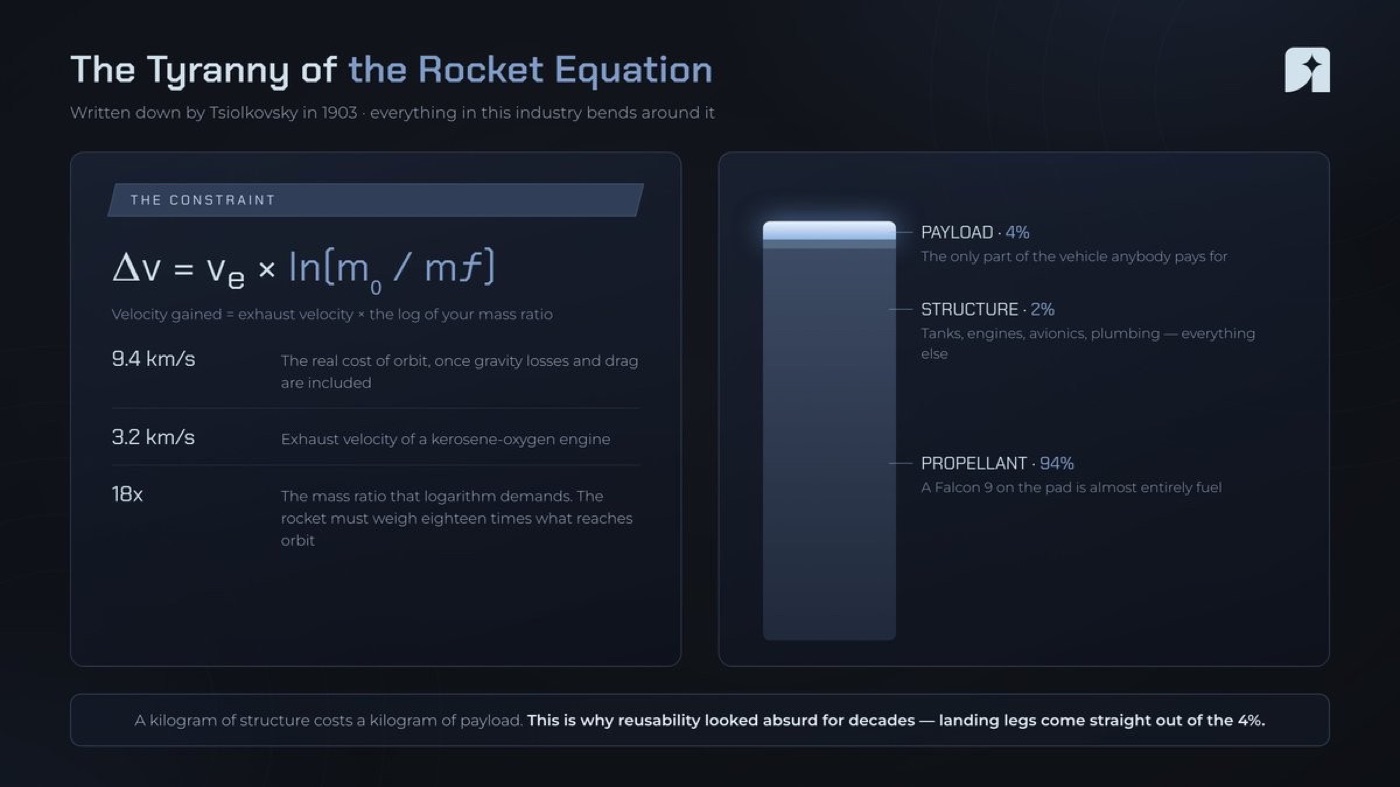
The cruel part is what that speed costs. A rocket carries its own fuel, which means every kilogram of propellant has to be accelerated by the propellant beneath it. Fuel needs fuel! Going faster does not cost proportionally more, it compounds.
In practical terms, roughly 94% of a Falcon 9 on the launch pad is propellant. About 4% is payload. The remaining 2% has to contain the tanks, the engines, the avionics, the plumbing and the structure holding it together.
A kilogram of structure costs you a kilogram of payload, and payload is the only part of the vehicle anybody pays for. It is also why reusability looked absurd for decades, since landing legs, grid fins and reserved landing propellant all come directly out of that 4%. Falcon 9 still pays that price today, carrying about 17,500 kilograms when it recovers the booster against 22,800 when it throws it away.
Due to this, the most important breakthrough has been being able to bring that cost down, well touch on this a little later below.
1 core customer
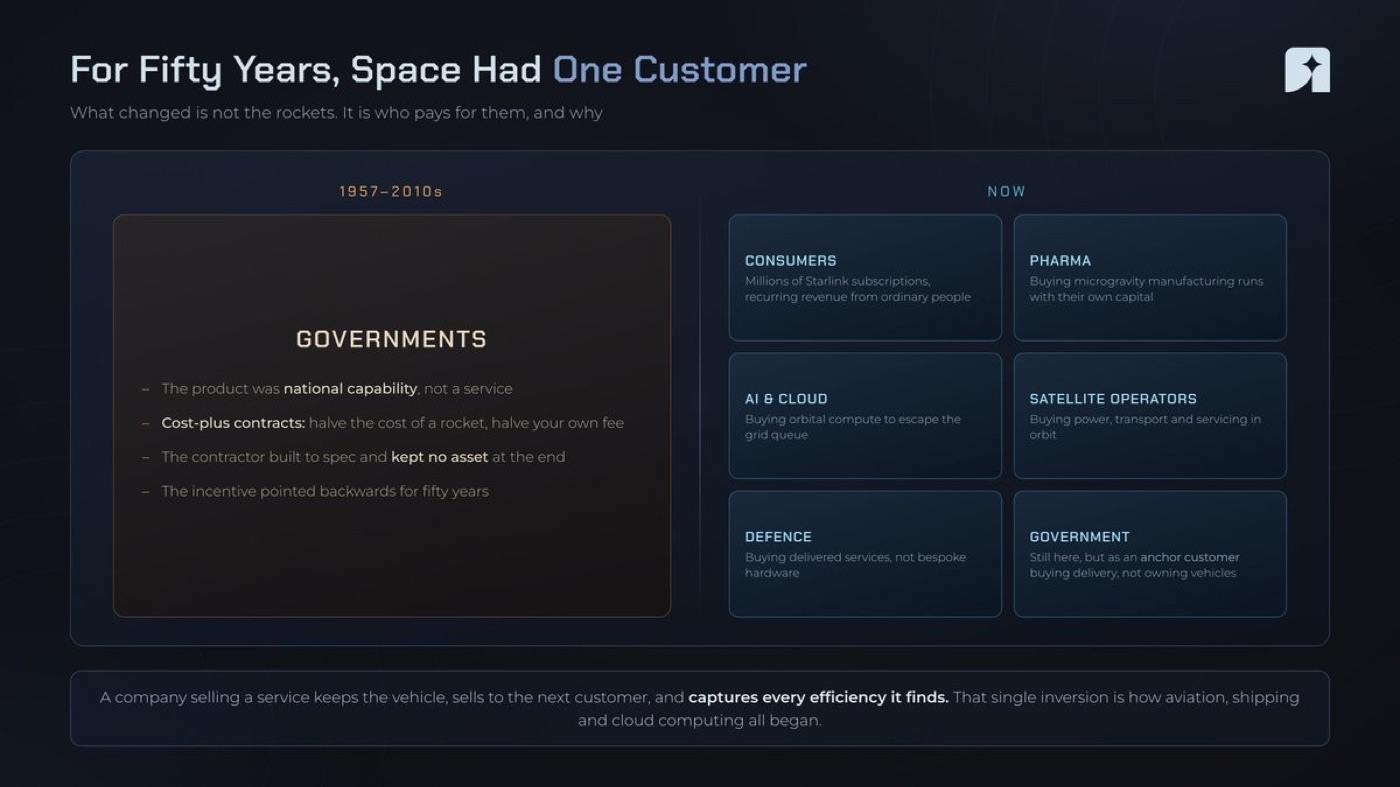
For most of the space age there was one customer and one product. Governments paid, and what they bought was national capability. Contracts were written on a cost-plus basis, meaning the contractor was reimbursed for whatever the work cost with an agreed margin added. Under that structure a company that halved the cost of building a rocket halved its own fee. The incentive pointed backwards for fifty years.
The Space Shuttle shows what that produced. When the programme was sold to Congress in the 1970s, the promise was routine access to orbit at around $600 per kilogram. It flew 135 missions between 1981 and 2011. Averaged across the programme and adjusted for inflation, each launch cost roughly $1.5 billion and delivered payload at about $54,500 per kilogram. The delivered number came in around ninety times the promise.
Satellites followed identical logic. A large communications satellite was a bespoke object costing somewhere between $150 million and $400 million, taking three to five years to design and build, and operating exactly once. Every single one was effectively a prototype. Engineers designed hardware they would never build again, for a launch that might slip two years, on a vehicle that would be destroyed in the act of delivering it.
In the end, nothing compounded, everything was just a one-off.
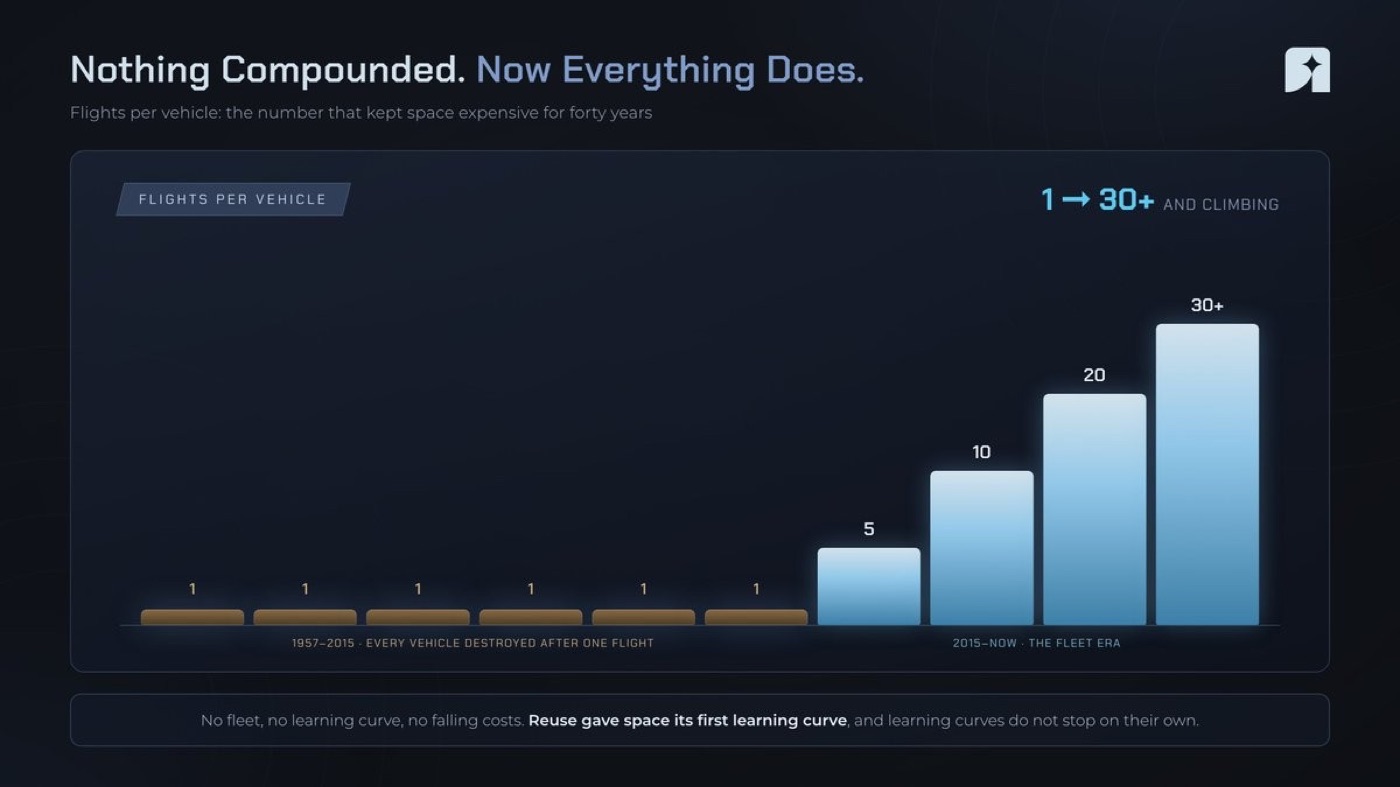
Every other industry gets cheaper because volume creates a learning curve. Build a million of something and the millionth costs a fraction of the first. Space had no volume. Each rocket was discarded after one use, so there was no fleet to learn from and no asset to depreciate across flights. Each satellite was unique, so no production line ever got refined. The cost curve stayed flat for four decades while computing fell by orders of magnitude.
This is the part I keep coming back to. The physics was never the obstacle, that was solved the physics in 1957. What kept space expensive for the following half century was an economic structure that removed every reason to make it cheaper, sitting on top of an equation that punished waste severely enough to make the whole thing look inevitable.Nothing in that arrangement could ever produce a ChatGPT moment. The capability existed and stayed locked behind a price that only a government could pay.
Where space sits on the curve
First comes installation, where the infrastructure gets built, capital is speculative, and the people funding it are mostly wrong about the timing. Then comes deployment, where the technology becomes ordinary and the value compounds for decades.
The part people usually miss is that infrastructure does not install all at once. It installs in layers, and each layer has to exist before the one above it becomes possible.
Railways laid track first. The towns, the freight businesses, the mail-order catalogues and the national retail brands came afterwards, and they came because the track existed. The internet built its backbone through the 1990s, and then cloud computing, streaming and everything mobile arrived on top of a network that was already paid for. Amazon Web Services launched in 2006, eleven years after the commercial internet began, and it was only possible because bandwidth had become cheap and boring. This is where space sits today too.
The launch layer is largely installed. Reusable rockets fly weekly. Pads exist and have been rebuilt for rapid turnaround. Satellites come off production lines. A kilogram to low Earth orbit costs a little over a thousand dollars, with prices eventually reaching $200/kg, with SpaceX pioneering and pushing capacity via launch. That layer has crossed from installation into deployment. It is becoming boring, which in infrastructure terms is the highest compliment available.
Everything above the launch layer has barely started. There is limited capacity to bring manufactured goods back down. Power available on orbit is measured in kilowatts at a time when industrial processes need megawatts. Commercial space stations do not exist yet and the International Space Station retires around 2030. In-space refuelling, orbital logistics and manufacturing at production scale are all sitting at demonstration stage, which means one or two flights and a press release.
That distinction is the whole thesis compressed into a paragraph. The expensive, brutal, capital-destroying part of the build has already been financed by somebody else. Getting to orbit was the thing that killed companies for fifty years and it is now a solved commodity purchase.
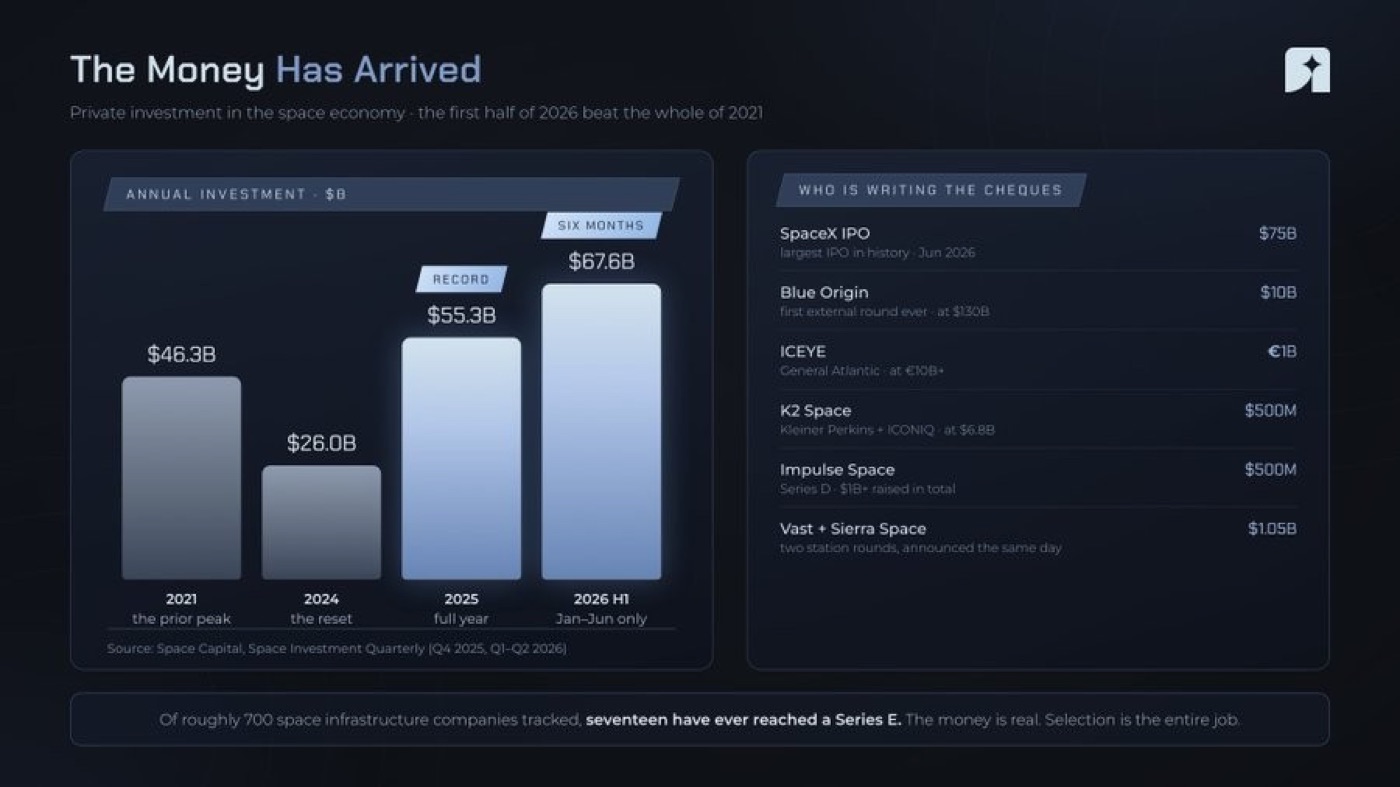
It also explains the timing of the money. Capital did not arrive in this sector because investors suddenly became romantic about space. When launch was the binding constraint, backing a space company meant underwriting whether the rocket would work. Now you can buy a ride the way you buy cloud compute, and the question becomes whether the business on top of it works. That is a normal venture question, and normal venture questions attract normal venture money at scale.
The three changes that make it different today
01Launch became cheap and repeatable
The mass ratio problem has one obvious escape route. If roughly 96% of what you launch is fuel and structure, and you throw all of it away on every flight, then the dominant cost of spaceflight has nothing to do with physics. You are destroying a machine worth tens of millions of dollars in order to deliver a few tonnes.
The analogy Elon Musk used for years was aviation. A Boeing 737 costs around $100 million. If you scrapped one after every flight, a ticket from London to New York would cost hundreds of thousands of dollars, and almost nobody would fly. Aviation works because the aircraft flies thousands of times and the airframe cost gets spread across all of them.
Rockets had never worked that way. The Shuttle was partially reusable and it made things worse, because refurbishing the orbiter between flights cost more than building an expendable rocket would have. Reuse only helps if the turnaround is fast and cheap, and the Shuttles was neither.
Falcon 9 changed that in December 2015 when a first stage landed vertically and was recovered intact. What matters more is what came next. Individual boosters have now flown well over twenty missions each. Turnaround dropped from months to weeks. The company built a fleet and started amortising it.
The numbers tell the story cleanly. Many years ago, launch costs sat in the 5 to 6 figure region and over the years this cost has been falling. Falcon 9 v1.1 brought that to about $3,700 by 2015. Falcon 9 Block 5 sits near $1,500 today. Starship, in its current configuration, is estimated at $900, with credible projections falling under $200 per kilogram later this decade if flight rates reach roughly ten missions per vehicle.
That is a fall of more than 90% inside two decades, and the curve has not flattened
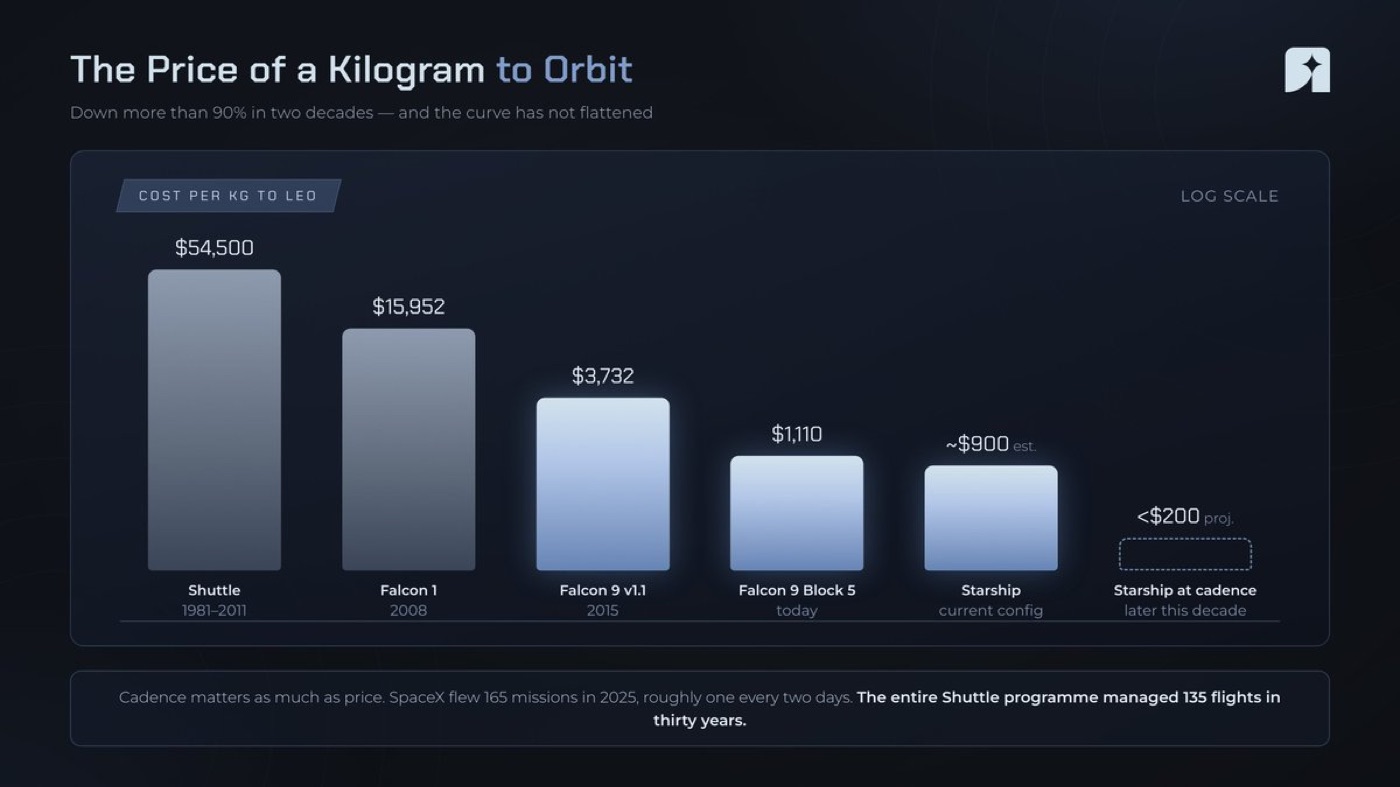
Cadence matters as much as unit cost and gets discussed far less. SpaceX flew 165 orbital missions in 2025, roughly one every two days, and carried about 80%+ of all mass humanity delivered to orbit that year. The entire Space Shuttle programme managed 135 flights across thirty years.
Frequency changes what is possible in a way price alone does not. When launches happen twice a week, a failed experiment can fly again next month rather than in three years. Hardware iterates. Companies plan around a schedule instead of praying for a slot. This is the difference between a research programme and an industry.
02The technology matured while Earth ran into limits
Cheap launch on its own would not have been enough. If you had handed the industry $1,500 per kilogram in 1995, very little would have happened, because almost nothing worth sending existed and nobody had a problem that orbit could solve.
Two things changed at once, and the collision between them is what makes this moment different.
What we can now build - Electronics miniaturised to the point where capability stopped tracking mass, satellites the size of shoe box can do the work that something a hundred times bigger could do decades before. That single change reset the economics, because the rocket equation punishes mass above everything else as we mentioned above.
Autonomy arrived alongside it, no more astronauts needed. A Falcon 9 booster lands itself on a moving barge without a human in the loop. Vardas capsule manufactures a pharmaceutical ingredient, decides when to come home, and reenters on its own. Every process that once needed an astronaut aboard has become a process you can run with a control loop, which removes the most expensive constraint in the industry, since human presence forces life support, abort systems and safety margins into every design.
Manufacturing became industrial. Satellites used to be assembled by hand over years. SpaceX now produces more spacecraft in a week than most nations have launched in their entire history.
What we now need - The other half of the story is that Earth developed problems shaped exactly like orbits advantages. AI turned electricity into the scarcest input in technology, with datacentres becoming a country-sized load on grids that take years to connect to. The energy transition needs clean power that works at night, and the storage to firm it remains expensive. Medicines most valuable products are fragile biologic drugs whose manufacturing is distorted by the one force no factory on Earth can switch off. Half the planet still lacks decent connectivity, because fibre will never reach it economically. Land, water, grid capacity and gravity itself have become the binding constraints on entire industries.
None of these problems existed at scale in 1995, when launch would have been the same price. Space became useful at the exact moment we developed needs that orbit is physically better placed to serve, and machines capable of operating there without people.
03A new customer appeared
The third change is commercial rather than technical, and it is the one that made everything fundable. The government historically designed the vehicle, owned the vehicle and paid a contractor a margin to assemble it.
That distinction is a big deal. A contractor building to specification has no reason to lower cost and no asset at the end. A company selling a service keeps the vehicle, sells it to other customers, and captures every efficiency it finds. The government became an anchor customer rather than an owner, which is how commercial aviation, shipping and cloud computing all began.
Then Starlink proved something nobody had demonstrated before, which is that a space company can earn recurring revenue from ordinary consumers.
The order of these three changes matters. Cheap launch made the road. Technology and demand created something worth putting on it. The commercial model made it possible to finance. Remove any one and the sector stays where it was in 2005.
Where will the value from space will lie?
There are 3 core overlaps where the value from the unlock lies and below, Ill outline these with energy, compute and manufacturing, plus the infrastructure that underlies them all.
Energy
The case for solar power in orbit rests on two numbers. Above the atmosphere, sunlight arrives at 1,361 watts per square metre, a figure called the solar constant. On Earth, that number drops over 20% because of energy dissipating within the atmosphere. It drops even further when you account for time. A solar farm in a strong location averages somewhere near 200 to 250 watts per square metre once you account for night, weather, seasons and the suns angle. In space, thats not something you need to consider, since a panel in the right orbit sees the sun almost continuously. Combine intensity with duration and the same square metre of silicon delivers something in the order of five to six times more energy per year in orbit.
The answer is that the buyers form a ladder, ordered by how much a watt is worth to them.
The first customers are other spacecraft. A satellite in orbit pays the equivalent of thousands of dollars per watt, because every watt it uses must come from panels and batteries it launched with. Selling power directly to satellites is the most valuable market, and it conveniently skips the hardest problem, since the beam never has to pass through the atmosphere.
The next customers are on Earth, but off the grid: military bases, remote islands, disaster zones and rescue operations, places where electricity arrives by diesel convoy and costs many times the grid rate. For them, power beamed to a portable receiver a few metres wide is not science fiction, it is a cheaper alternative to what they pay today.
Further down the ladder, sunlight itself becomes the product, with orbital mirrors extending the working hours of solar farms on the ground.
The bottom rung, beaming gigawatts into the terrestrial grid at utility prices, is the famous vision from the 1960s, and it remains the furthest away.
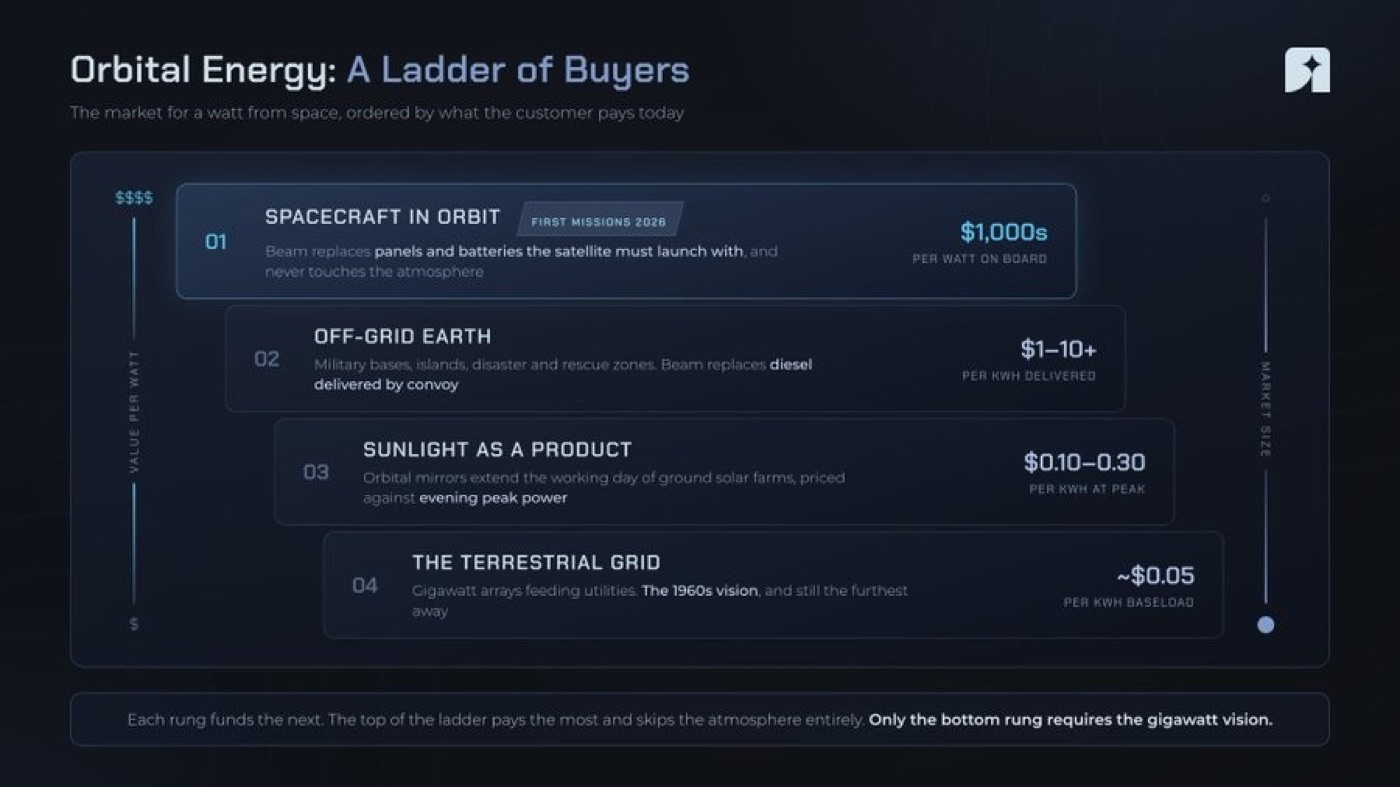
This ladder is what changed the investment case. The old version of space solar had to solve everything at once: kilometre-wide receiving antennas, utility-scale costs, and decades of buildout before the first dollar of revenue. The new version starts at the top of the ladder, where customers already exist and will pay the most, and works downward as launch costs fall and beaming technology matures. The first commercial power-beaming missions fly in 2026.
Compute
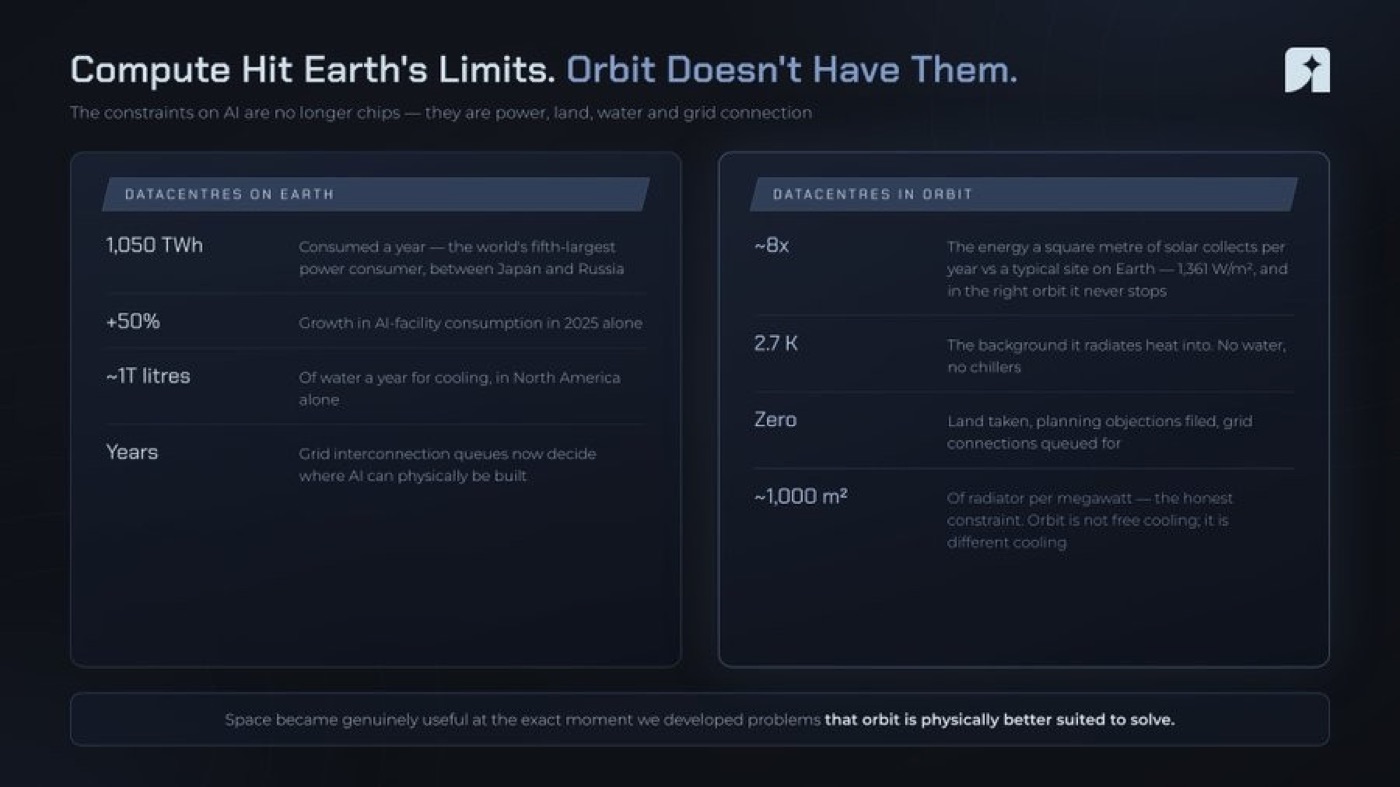
AI has turned electricity into the binding constraint on computing. Data centre power demand is set to more than double by 2030, and the industrys bottleneck is no longer chips. It is power, cooling, land and permission. New facilities wait years for a grid connection, consume enormous volumes of water, and fight local opposition for every site.
Orbit answers all four problems at once:
Power - the sun shines continuously, with no grid connection to wait years for and no batteries to buy.
Cooling - heat radiates straight into deep space, without a litre of water.
Land - there is no site to acquire, and capacity scales by launching more, not by building more.
Permission - one licence covers the constellation, with no neighbours, no zoning and no site-by-site planning fights.
The physics is on spaces side too. With no air in vacuum, a data centre sheds heat by radiating it away, and deep space is the coldest heat sink in existence, a constant three degrees above absolute zero. A radiator pointed at it works passively, forever, with no chillers, no cooling towers and as mentioned, no water requirement. The whole problem reduces to putting large, light sheets into orbit cheaply, which is exactly the cost curve we have mentioned above.
The people best positioned to know agree. SpaceX has filed to deploy up to one million compute satellites, targeting 100 gigawatts of capacity per year by 2030, with prototypes flying in 2027, each carrying a compute payload on a structure wider than a 747.
Musk puts it simply: the lowest cost place for data centers is space. Google is flying prototype TPUs under Project Suncatcher, and Starcloud has already operated an Nvidia H100 in orbit. The remaining challenges, radiation-tolerant hardware and serviceability among them, are engineering problems rather than open questions, and every one of them gets cheaper to solve as launch costs fall.
Manufacturing
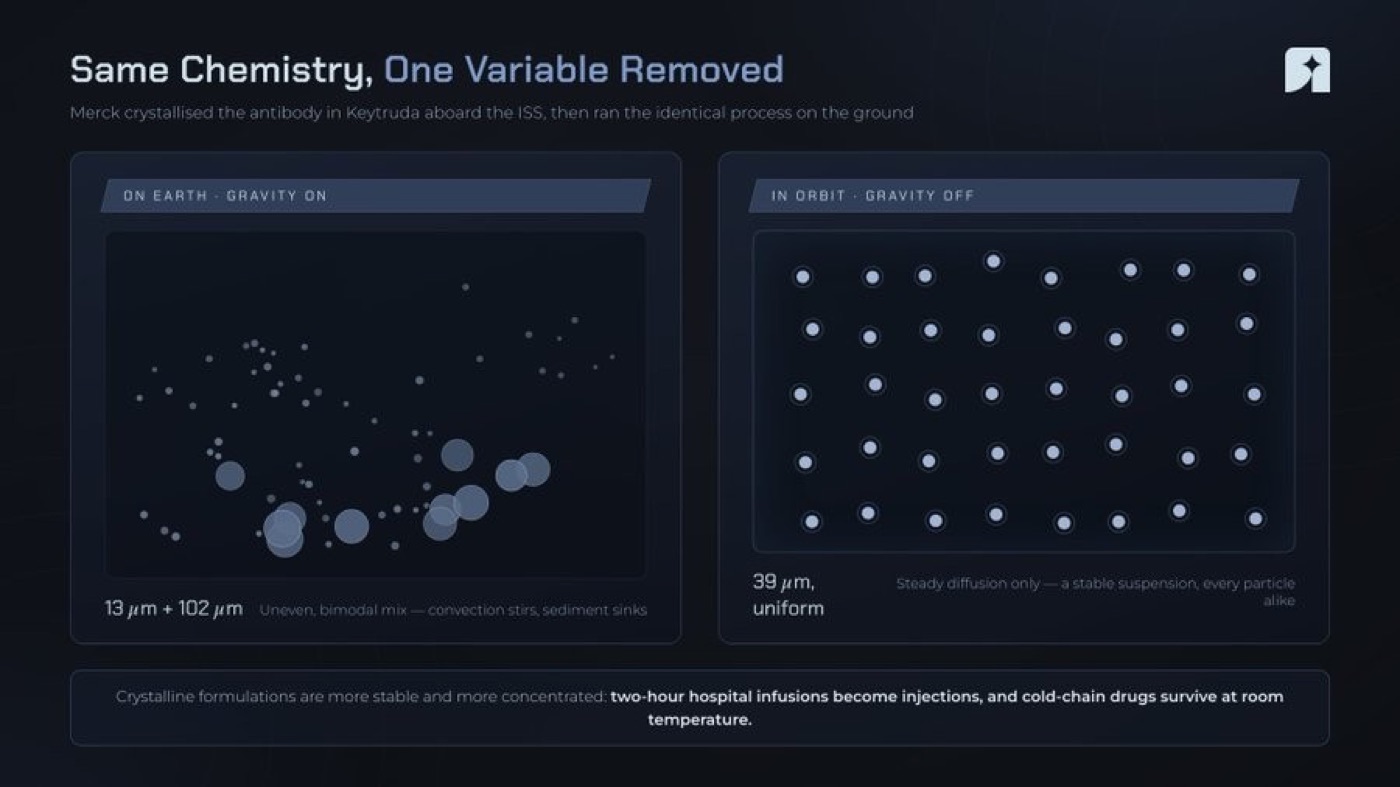
The physics here is the most settled of the three, and it comes down to what gravity does to a fluid. On Earth, gravity never lets a liquid sit still, heavier fluid sinks, lighter fluid rises, and anything growing in a solution, like a crystal, gets fed in convection currents rather than steadily with dense particles sinking to the bottom before the process finishes. Once you remove gravity all of that stops and a liquid goes perfectly still, material arrives at a growing crystal slowly and evenly, from every direction at once. Orbit is the only place where you can switch gravity off, and stillness turns out to be a manufacturing tool, particularly in pharma, where we recently covered the case for microgravity drug manufacturing in my most recent article.
The proof is already measured. When Merck crystallised the antibody in Keytruda, the worlds best-selling cancer drug, aboard the ISS, it got a uniform suspension of particles clustered at 39 micrometres. Uniform crystals are not a curiosity since they can turn a drug that requires hours of IV infusion in a hospital into an injection administered at home because of laminar flow.
That is why the first buyers are pharmaceutical companies, considering a better crystal form of an existing drug is a new formulation, and a new formulation means new patents and a better product in a market worth billions per drug. The buying has started with United Therapeutics putting its own capital into microgravity formulation work with Varda Space Industries whose reentry capsules crystallise drugs in orbit and bring them home, and which is roughly doubling its flight cadence next year on the way to a reusable vehicle ten times larger. Beyond pharma, the same physics sells to buyers of exotic optical fibre, semiconductor crystals, alloys that separate under gravity, and engineered tissue that holds its three-dimensional shape only in orbit.
Given my background, this is one subdomain Im mega bullish on.
Further out sits tissue. Engineered tissue collapses under its own weight on Earth, so it has to be grown on scaffolds that constrain what you can build. In orbit it holds its shape and this in my opinion, has the opportunity to drastically change medicine via organ transplantation forever.
The infrastructure underneath
The orbital version of the infrastructure needed to make all of the above succeed is being built today piece by piece, and each piece serves every layer above it at once:
- More rides up. Blue Origins New Glenn is flying and Rocket Labs Neutron is close behind, which means the launch market is becoming a competitive market rather than a single supplier. Competition is what keeps the cost curve, the one every layer in this essay depends on, falling.
- Somewhere to operate. Vasts Haven-1, the first commercial space station, has finished integration ahead of a 2027 launch, with Axioms multi-module station behind it. These are the industrial parks of orbit: pressurised, powered, crew-tended platforms where manufacturing runs that need a human hand can happen at scale.
- Power on tap. The orbital power grids being built for satellites are also the utility layer for everything else. A compute cluster or a factory that can buy watts in orbit instead of launching its own oversized arrays gets lighter and cheaper, which makes every business case above close sooner.
- A way to move around. Orbital refueling and propellant depots, with Starships in-orbit transfer at the front, turn spacecraft from disposable objects into serviceable ones. Tugs and refueled stages move cargo between orbits the way trucks move freight between ports.
- A way home. Reentry capsules, the kind Varda already flies, are the return logistics of the manufacturing layer. A factory is only as good as its shipping department.
A way home. Reentry capsules, the kind Varda already flies, are the return logistics of the manufacturing layer. A factory is only as good as its shipping department.
Here is the investment logic that falls out of this structure. Energy, compute and manufacturing are each a bet on a specific market emerging with infrastructure itself, a bet that any of them does. The station operator earns from the pharma run and the semiconductor run alike. The refueler earns from the power constellation and the compute constellation alike.
In finance, we talk about compounding and that happens directly here. Cheap power in orbit makes orbital compute cheaper, stations make manufacturing scalable, and every new customer makes the next launch cheaper for everyone.
How this is going to improve humanity forever
As a doctor, I often think about the work being done to improve himanity at more scalable levels. When I would work in a busy ED, you'd see only x number of patients per shift. Part of why I felt compelled to try new things and how Ive ended up working on Starcap is that the labour of capital can help scale things to new levels and with space, the impact can be seen across sectors close to my heart.
Medicine. The most valuable drugs in the world are injectable biologics, and seven of the ten highest-earning medicines are proteins or peptides rather than pills. Those molecules are difficult to concentrate, unstable, and almost all require an unbroken refrigerated chain from factory to patient.
Energy. The compute story and the energy story are the same story. Datacentres are heading toward terawatts of hours a year, a country-sized load appearing inside two decades, and every gigawatt competes with homes and hospitals for the same grid. Moving part of that demand off the planet decouples computation from terrestrial power infrastructure at the point where the two have started to fight.
Watching the planet. This is already delivering value at scale and gets the least attention. Radar satellites see through cloud and darkness, which optical satellites cannot. That tells a farmer what their crop is doing, an insurer where a flood reached, a responder which roads survived.
Connection. Satellite constellations already deliver broadband where laying fibre will never make economic sense. Many of us have had the chance to feel this already with Starlink, something Ive thoroughly enjoyed more recently on flights where previously having wifi was unheard of, not to mention, slow.
The frame underneath all of it. Every industrial process humanity has ever run has taken place inside a thin shell of atmosphere on a single planet with finite land, finite fresh water and a shared grid. The argument for space is that the shell is not the only option any more.
The companies and the money
There are many companies pioneering the vision laid above and below I wanted to mention many of them including what problems they are solving today. We'll briefly touch upon a few that I think are doing wonderful work today.
Varda Space Industries - Microgravity Pharma Builds autonomous orbital capsules that manufacture pharmaceuticals in microgravity and fly them home. Founded by Will Bruey , raising over $300m.
Starcloud - Orbital Compute GPU datacentres in orbit, have an Nvidia H100 flying since November, the first LLM trained in space in December. Earths datacentres are hitting power, water and grid walls. Orbit has continuous solar and free cooling. Founded by Philip Johnston raised over $200m
Axiom Space - Infrastructure Four private crewed ISS missions flown, first commercial station modules in build, orbital data-centre nodes already launched. The ISS retires around 2030 and someone has to own the successor. Founded by Kam Ghaffarian ; closed $525m.
Star Catcher - Space Power. Building the first power grid in space beaming concentrated sunlight to customer satellites existing solar arrays, no receiver hardware needed. Power is the binding constraint on everything in orbit, and Star Catcher sells it as a utility. Founded by Andrew Rush and raised over $50m, with a record 1.1kW beaming demo and six power purchase agreements signed.
BioOrbit Orbit - Microgravity Pharma by Katie King, PhD building BOX, a microwave-sized autonomous unit that crystallises antibody drugs in orbit, turning hospital IV infusions starting with cancer drugs into at-home injections. The same crystallisation physics as Varda, applied squarely at the patient-delivery end. This is a phenomenal company.
Sierra Space Space - Infrastructure Dream Chaser spaceplane, LIFE inflatable habitats and a $740M defence satellite business. Manufactured goods need a gentle runway landing home, not a splashdown.
Relativity Space - Heavy Industry Terran R, a reusable heavy-lift rocket. The market wants a second source of heavy lift, with $3B of contracts waiting on capacity. CEO by Eric Schmidt , $1.3B raised, first launch targeted late 2026.
Impulse Space - Logistics Mira transfer vehicles and the Helios kick stage - low orbit to geostationary in eight hours. Rideshare drops you at the bus stop; Impulse takes you to the door. I think of them as Amazon Prime for same day delivery for wherever you need to go in space. Founded by Tom Mueller , the first employee at SpaceX and the man who designed their engines!
Vast - Infrastructure Haven-1, on track to be the first commercial space station in history. The ISS replacement problem, attacked at startup speed. Founded by @JedMcCaleb with over $1B of his own capital, run by Max Haot , first external round of $500m
Space Solar - Space Solar Kilometre-scale satellites collecting solar power in orbit and beaming it down continuously. Baseload clean energy with no land, no weather, no night first target is 30MW to Iceland by 2030.
Orbit Fab - Logistics Gas stations in space refuelling ports, transfer nozzles and the first depots. Satellites currently die with dry tanks.
D-Orbit - Logistics ION orbital transfer vehicles with 22 commercial missions flown, the deepest flight heritage in the layer. Last-mile delivery in orbit, already revenue-generating with triple-digit growth. Raised over $150M
Stoke Space - Building fully 100% reusable rocket whose engine cycle only SpaceX has ever flown. The reusable upper stage is launchs last cost frontier. Founder Andy Lapsa , first flight targeted for the end of 2026.
APEX Space & Defense Systems - Logistics Standardised satellite buses manufactured at rate, with factory capacity for 200+ a year. Buses were bespoke and slow; Apex productised them.
Space Forge - CEO Joshua Western , Infrastructure Returnable satellites growing semiconductor crystals in orbit, fired the first commercial semiconductor furnace in space in December. Perfect wafers want zero-gravity vacuum the unproven return leg is the bet. One of the biggest
Blue Origin - Logistics New Glenn heavy lift, Blue Moon landers, BE-4 engines. The only credible counterweight to SpaceX in heavy lift - landed and reflew boosters before losing a vehicle on the pad in May. The one and only, Mr Jeff Bezos.
K2 Space Corporation - Infrastructure Mega-class satellites with 20 kilowatts of power, mass-manufactured for Starship-era economics; Gravitas has been flying since March. Cheap lift makes big, power-rich satellites the rational default. Founded by Karan Kunjur
Isar Aerospace - Logistics Spectrum, the first privately developed orbital rocket to launch from continental Europe. Europes sovereign-launch bet, aiming at 40 vehicles a year. Founded by Daniel Metzler , €870M raised, the most of any European launch startup, with Flight 2 imminent.
What the moment looks like
So what is the ChatGPT moment for space, and how will we know it when it arrives?
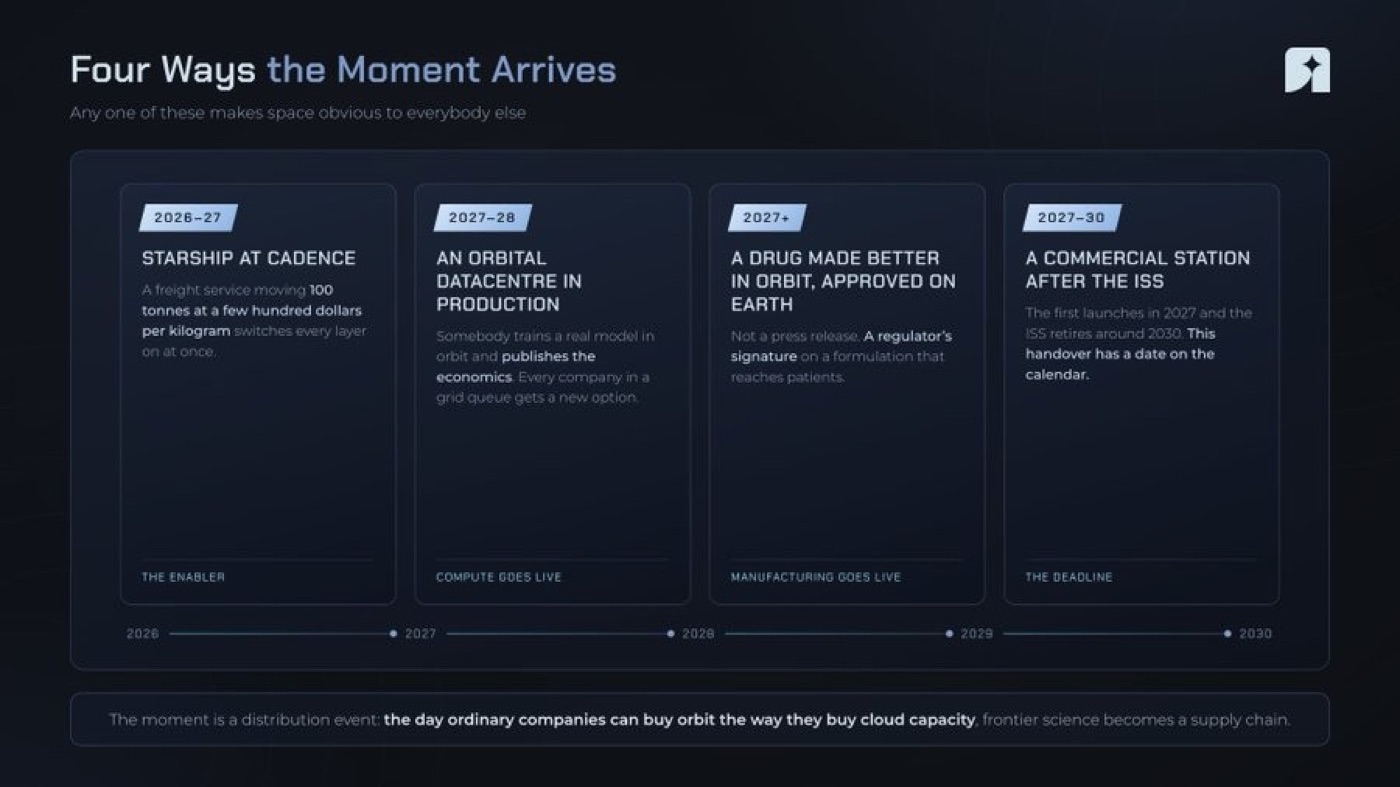
It will not be a rocket launch. Falcon 9 landings were astonishing in 2015 and are routine now, and routine is the point. The moment arrives when something built on top of cheap launch starts working in public. Four candidates stand out, and any one of them would do it.
Starship flying at cadence with real payload. A freight service moving a hundred tonnes at a few hundred dollars per kilogram does not improve the layers above it, it switches them on all at once. Every business case in this essay closes faster the day that schedule holds.
An orbital datacentre serving production workloads. The moment somebody trains a real model on hardware in orbit and publishes the economics, every company staring at a grid queue has a new option. SpaceXs prototypes fly in 2027 with commercial service targeted for 2028.
A drug made better in orbit, approved on Earth. Not a press release about an experiment, but a regulators signature on a formulation that reaches patients. Vardas work with United Therapeutics puts a first flight in 2027.A commercial station operating after the ISS. The first one launches in 2027, and the ISS retires around 2030, so this handover has an actual date on the calendar.
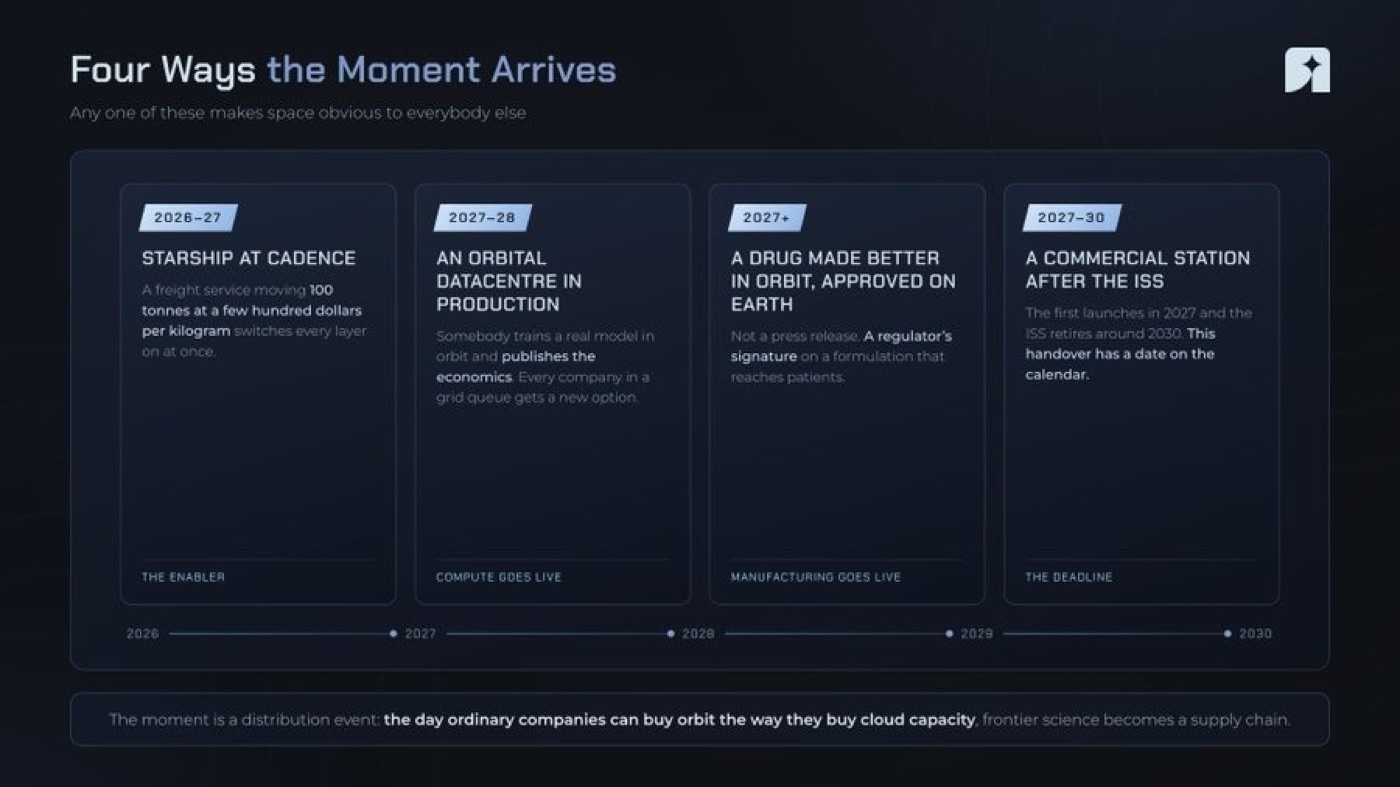
The day a mid-sized pharma firm orders a microgravity manufacturing run the way it orders a clinical trial, or a company rents orbital compute the way they rent cloud capacity, this stops being frontier science and becomes a supply chain. We've known about these capabilities for a long time, now the time is to grow them at scale commercially so we dont even think twice about these things. That day is coming.
Close
I keep coming back to the patient in the chair with a cannula in their arm.The molecule going into them is one of the great achievements of modern science. The apparatus around it belongs to another century. The chair, the pump, the travel, the refrigeration behind all of it, that is the inheritance of making medicine under conditions we never chose and never questioned.
Every drug made in history has been made under the force of gravity. Every crystal, every protein, every cell culture, all of it under one constant that no chemist ever got to switch off. We've known the potential for a long time, but for the first time ever, the economics make sense, the time is to make these commercial unlocks scalable. That gap is where the next decade of value gets created, and the companies filling it are private, early and mostly unknown to the people who will eventually own them.
At Starcap we spend our time researching this sector because it is the clearest case we have found of something that genuinely cannot be done better on the ground.